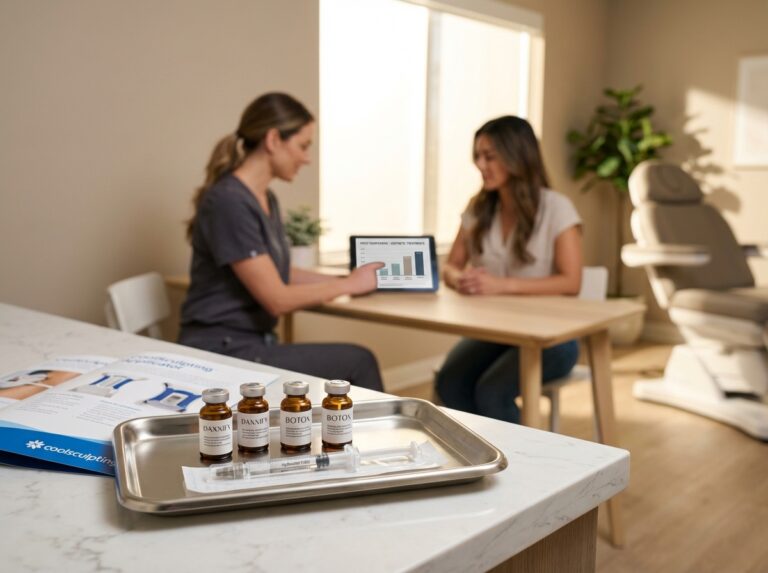
Xeomin’s ‘naked’ formulation is marketed as a purer botulinum toxin alternative to Botox — but is it actually cheaper? This article explains what makes Xeomin different, how clinics set prices for botulinum toxin and other nonsurgical treatments in the US, and gives practical tips to compare quotes and avoid overpaying before you book. Learn typical price ranges and smart questions to ask at consults.
What Xeomin Is and Why ‘Naked’ Matters
You hear the term “naked injectable” thrown around in consultation rooms a lot these days. It sounds like a marketing buzzword, and to some extent, it is. But when you strip away the branding, that word describes the specific chemical engineering that separates Xeomin from its competitors. Understanding this difference is the key to knowing why it often costs less and whether it is the right choice for your face.
What is Xeomin Actually Made Of?
At its core, Xeomin (incobotulinumtoxinA) is a neuromodulator, just like Botox. They both use the same active ingredient: botulinum toxin type A. This is the substance that interrupts the signal between your nerve and your muscle, causing the muscle to relax and the wrinkle above it to soften.
The difference lies in the packaging of that molecule. When botulinum toxin is manufactured, the active molecule is naturally surrounded by accessory proteins. Think of these proteins like a protective shell or a wrapper around a piece of candy.
The ‘Naked’ Definition
When we say Xeomin is “naked,” we mean it has gone through an extra purification process to remove those accessory complexing proteins. It is pure botulinum toxin type A. Botox, on the other hand, keeps those proteins attached. This doesn’t make one “dirty” and the other “clean,” but it does change the biological footprint of the drug. Xeomin contains only the therapeutic component needed to stop the muscle movement, without the extra protein baggage.
Clinical Implications: Does Purity Change Results?
You might assume that a “pure” product is stronger, but in clinical practice, the potency is generally considered equivalent to Botox. If you are used to getting 20 units of Botox in your frown lines, you will likely need 20 units of Xeomin to get the same result.
Onset and Duration
The timeline for Xeomin is very similar to what you expect from other toxins. You won’t leave the clinic looking different. The product typically starts working around day 3 or 4. Full results settle in by day 14. As of late 2025, most patients see results last about 3 to 4 months. Some data suggests that because Xeomin lacks those heavier proteins, it might bind to receptors slightly faster for some people, but for the average patient, the schedule is identical to Botox.
The Antibody Theory
This is the main medical argument for choosing a naked injectable. The theory is that the human body can develop antibodies to foreign proteins. Since Botox has more foreign proteins (the complexing proteins), there is a higher theoretical risk that your body could identify it as an intruder and build resistance to it over time. If that happens, the treatment stops working. Because Xeomin lacks these proteins, it is less likely to trigger that immune response. If you have been getting injections for ten years and feel like they aren’t working as well anymore, your injector might switch you to Xeomin for this exact reason.
FDA Approved Uses
It is important to know what you are paying for legally. In the United States, Xeomin is FDA-approved for cosmetic use to treat moderate to severe glabellar lines (the “11s” between your eyebrows).
However, doctors use it “off-label” every day for other areas. This is standard practice in aesthetic medicine. Common off-label spots include:
- Horizontal forehead lines
- Crow’s feet (lines around the eyes)
- Bunny lines (nose)
- Lip flips
- Chin dimpling
Beyond aesthetics, Xeomin has FDA approval for therapeutic issues like cervical dystonia (neck spasms), blepharospasm (eyelid spasms), and upper limb spasticity. This medical track record is important because it validates the safety profile of the drug at much higher doses than what you get for wrinkles.
Safety Profile and Side Effects
Since Xeomin and Botox share the same active ingredient, their safety profiles are nearly mirror images. The risks usually come from the injection technique rather than the fluid in the syringe.
Common Reactions
Most people experience minor redness or swelling at the injection site that disappears within 20 minutes. Bruising is possible, especially if you take blood thinners or fish oil, but that is a result of the needle hitting a vessel, not the drug itself. Headaches are reported by a small percentage of patients in the first 24 to 48 hours.
Rare but Serious Risks
If the toxin spreads to unintended muscles, it can cause temporary drooping. This is called ptosis. If injected too low on the forehead, your eyebrows might feel heavy. If injected incorrectly near the eye, the eyelid can droop. These side effects are temporary and wear off as the toxin metabolizes, but they are the reason you should prioritize injector skill over the cheapest price per unit.
Comparison: Xeomin vs. Botox vs. Dysport
When you are looking at a clinic’s price list, you will usually see these three names. Understanding their physical differences helps explain why the prices vary.
Xeomin (The Pure Option)
As we discussed, this is the naked tox. It does not need to be refrigerated before reconstitution (mixing), which simplifies storage for clinics. Wholesale, it is generally cheaper for clinics to buy than Botox—often costing providers around $4 to $5 per unit compared to Botox’s $6 to $7. This lower overhead is why you often see Xeomin priced at $10 to $17 per unit while Botox sits higher. It is a 1:1 unit ratio with Botox.
Botox (The Brand Leader)
Botox (onabotulinumtoxinA) is the gold standard simply because it was first. It has the most clinical data and the highest brand recognition. You are paying a premium for that trust and the massive marketing machine behind it. It contains the accessory proteins. It is also a 1:1 unit ratio.
Dysport (The Spreader)
Dysport (abobotulinumtoxinA) is a bit different. It has smaller protein molecules and tends to diffuse (spread) more than Botox or Xeomin. This makes it excellent for large areas like the forehead (often requiring fewer pokes) but trickier for precise areas where you don’t want the product to move. The math is also different; you typically need 3 units of Dysport to equal the strength of 1 unit of Botox or Xeomin. So, if you see Dysport priced at $5 per unit, do not be fooled—it is not half the price. You just need three times as much fluid.
| Feature | Xeomin | Botox | Dysport |
|---|---|---|---|
| Formulation | “Naked” (No additives) | With complexing proteins | With complexing proteins |
| Unit Ratio | 1 (Standard) | 1 (Standard) | 3 (Approximate) |
| Spread | Moderate/Precise | Moderate/Precise | Higher Spread |
| Avg Price (2025) | $10 – $17 / unit | $12 – $20 / unit | $4 – $8 / unit (x3 needed) |
Does the Formulation Justify the Price Difference?
Technically, Xeomin’s manufacturing process is highly sophisticated, yet it remains more affordable. The price difference you see on your bill is rarely about efficacy. It is about wholesale costs and branding. Allergan (the maker of Botox) spends millions on advertising and loyalty programs like Allē. Merz (the maker of Xeomin) has a different strategy, often focusing on the “clean” aspect and pricing the product lower for providers. Clinics often pass those savings to you to encourage you to try something other than the big brand name.
If you are budget-conscious but want the same safety profile and efficacy as the market leader, the “naked” formulation of Xeomin offers a logical way to lower your bill without compromising on the actual medical results. You aren’t getting a discount product; you are getting a product that simply skipped the expensive protein coat and the Super Bowl commercials.
How Clinics Price Xeomin and Other Injectables
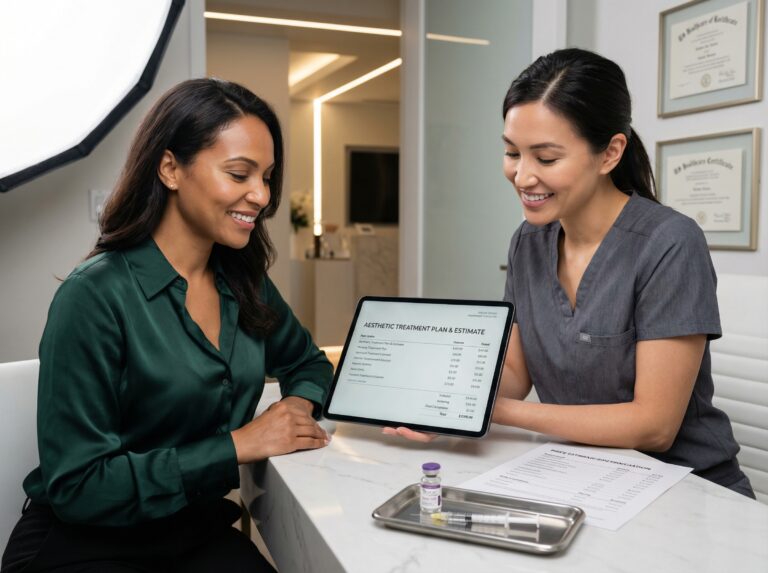
Understanding the chemistry of a “naked” injectable is useful, but knowing how that translates to your credit card bill is practical. Pricing in the US aesthetic market is rarely transparent. You might see a flyer for $9 per unit and assume it is a steal, only to find out you need three times as much product.
Clinics use specific formulas to determine what you pay. Understanding these models helps you compare quotes accurately.
Common Pricing Models
Most clinics in the US stick to one of four pricing structures. Knowing which one your provider uses is the first step to avoiding surprise costs.
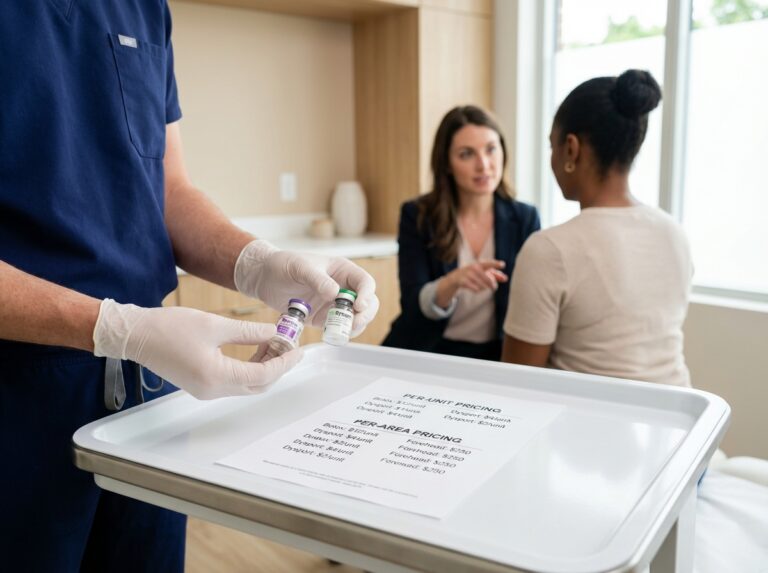
Per Unit Pricing
This is the most common and transparent method. You pay for exactly the amount of neurotoxin used. If a clinic charges $14 per unit and you need 20 units, you pay $280. This is fair because you do not subsidize other patients who need higher doses. However, you must trust the injector not to over-treat just to sell more units.
Per Area Pricing
Some practices charge a flat rate for a “forehead” or “crow’s feet” treatment. This offers predictability. You know the total cost before you sit in the chair. The downside is significant. If you have weak facial muscles and only need a small dose, you overpay. You are essentially paying for the heavy dose someone else requires.
Tiered or Package Pricing
Clinics often bundle treatments. You might see an offer for “30 units of Xeomin plus one syringe of filler” for a set price. These can offer real value if you actually need everything in the package. Often, patients end up buying more than they intended because the bundle seemed like a deal.
Membership Models
Monthly subscriptions are trending in 2025. You pay a monthly fee, perhaps $150, which banks into a “wallet” for treatments at a discounted rate. This works well for maintenance if you are loyal to one provider. It is a bad idea if you like to shop around or only treat once a year.
Typical 2025 Price Ranges
Prices vary wildly based on geography. A clinic in Manhattan or Los Angeles charges significantly more than one in the Midwest. The following ranges reflect typical US pricing as of late 2025.
| Product | Price Per Unit | Typical Full Face Cost (50 Units) |
|---|---|---|
| Xeomin | $10 – $17 | $500 – $850 |
| Botox | $12 – $20 | $600 – $1,000 |
| Dysport | $4 – $8* | $600 – $1,200 |
| Daxxify | $15 – $25 | $750 – $1,250 |
*Note on Dysport: It is cheaper per unit, but you typically need 3 units of Dysport to equal the strength of 1 unit of Botox or Xeomin. The total treatment cost usually evens out.
Cost by Treatment Area
To budget effectively, you need to know the total cost for specific zones. These estimates assume average muscle strength. Men or those with very strong muscles will pay more.
- Glabellar Lines (Frown Lines): Typically requires 18–25 units. Xeomin costs $216 to $425 for this area; Botox usually runs $300 to $600.
- Forehead Lines: Typically requires 15–20 units. Xeomin ranges from $180 to $340; Botox ranges from $225 to $500.
- Crow’s Feet: Typically requires 5–12 units per side. Treating both eyes with Xeomin costs between $120 and $400 total; Botox generally costs $150 to $600.
Fillers and Devices
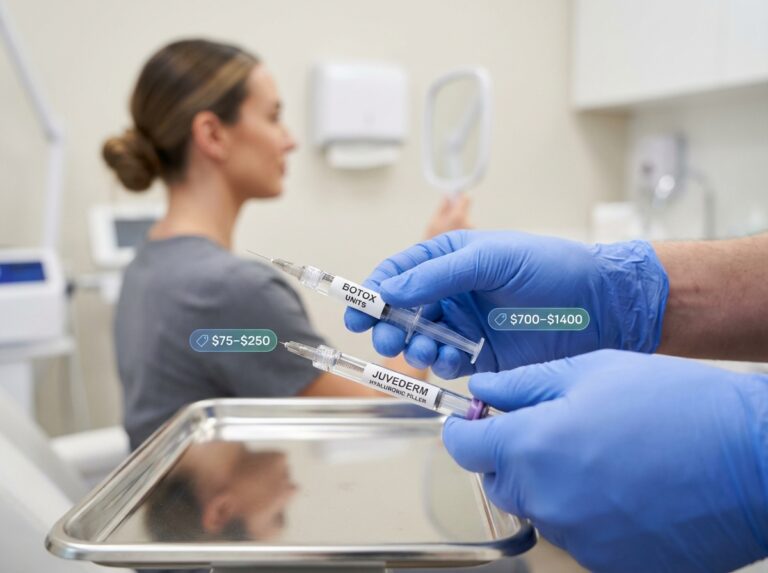
Comparing injectables to other treatments helps contextualize the cost. Hyaluronic acid fillers (like Juvederm or Restylane) generally cost $650 to $900 per syringe. A full “liquid facelift” often requires 2 to 4 syringes. Non-surgical fat reduction like CoolSculpting typically costs $600 to $800 per cycle, with most patients needing multiple cycles per area.
Why Prices Vary So Much
You might find two clinics on the same street with a $5 per unit price difference. Several factors drive these numbers.
Provider Expertise
This is the biggest variable. A board-certified dermatologist or plastic surgeon charges a premium for their medical education and anatomical knowledge. A registered nurse injector or physician assistant typically charges less. You are paying for the hand holding the needle, not just the liquid inside it.
Wholesale Product Costs
Clinics pay different amounts for the product. As of 2025, the wholesale cost for a vial of Botox is roughly $600 to $700. Xeomin is generally cheaper for clinics to buy, costing around $400 to $500 per vial. This lower overhead allows clinics to price Xeomin lower while maintaining their profit margin.
Overhead and Location
A medical spa with marble floors in a high-rent district passes those facility costs to you. A smaller, clinical office has lower overhead.
Dilution Practices
Botulinum toxins come as a powder. The provider adds saline to turn it into an injectable liquid. Standard dilution ensures potency. Some unethical clinics over-dilute the product. They add too much saline to stretch the powder further. This lowers their cost but gives you a weaker treatment that wears off faster.
How to Request and Compare Quotes
Never book an appointment based on a generic price list. Call the clinic or send a message with specific questions. This signals that you are an educated patient.
Ask These Specific Questions:
- “What is your price per unit for Xeomin specifically?”
- “Do you charge a consultation fee, and is it applied to the treatment cost?”
- “Who performs the injection? Is it a doctor, nurse practitioner, or RN?”
- “What is your reconstitution ratio?” (Asking this technical question about dilution puts them on notice that you are informed).
- “If I need a touch-up in two weeks, is that included or charged per unit?”
- “Do you participate in the Xperience+ loyalty program?” (This is the rewards program for Xeomin that can save you money).
When comparing quotes, look at the “price per effective treatment” rather than just price per unit. If Clinic A charges $10 per unit but claims you need 40 units for your forehead, and Clinic B charges $14 per unit but says you only need 20, Clinic B is actually cheaper ($280 vs $400).
Red Flags and Warning Signs
Everyone loves a deal, but bargain hunting for medical procedures is dangerous. Be wary of prices that seem too good to be true.
The “Groupon” Effect
Deeply discounted treatments on coupon sites often come from clinics struggling to find patients. They may be inexperienced or using near-expired products.
Price Per Unit Under $9
Given the wholesale costs in 2025, a price below $9 or $10 per unit for Botox or Xeomin usually means the clinic is losing money or cutting corners. They might be over-diluting the product or using “gray market” imports that are not FDA-approved.
Product Authenticity
Legitimate clinics will not hesitate to show you the vial. Xeomin comes in a specific box with a hologram. Ideally, the injector draws the product up in the room with you. If they bring in pre-filled syringes from a back room, you have no way of knowing if it is Xeomin, Botox, or a diluted generic.
“Banking” Pressure
Be cautious of clinics that pressure you to buy hundreds of units upfront to “lock in” a low price. This ties your money to them before you have seen their work.
No Brand Disclosure
If a clinic advertises “Anti-Wrinkle Injections” without naming the brand, ask why. You have a right to know if you are getting Botox, Xeomin, Dysport, or a newer competitor like Letybo. Comparing specific brands is the only way to ensure you are getting fair market value.
Smart pricing research protects your wallet and your face. Once you have a clear quote, you can move on to the practical details of booking and preparing for your appointment.
Conclusions and Recommendations
We have reached the end of our deep look into the world of neuromodulator pricing. You now have the data on Xeomin and how it compares to the industry giant Botox. The numbers tell a clear story, but your final bill might tell a different one. It is time to bring all these facts together so you can make a smart decision for your face and your wallet.
The Verdict on Price Competitiveness
The short answer is yes. Xeomin is generally cheaper than Botox. In late 2025, we see Xeomin averaging between $10 and $17 per unit across the United States. Botox typically sits higher at $12 to $20 per unit. If you are treating a standard area like the forehead or glabellar lines, this price gap adds up.
A full face treatment usually requires about 50 units. With Xeomin, you might pay around $500 to $850. The same treatment with Botox often lands between $600 and $1,000. That is a potential savings of $100 to $150 per session. If you go three or four times a year, you are looking at saving enough for a decent weekend getaway.
However, price per unit is not the only thing that matters. The total cost depends on how many units your muscles actually need. Some people find that Xeomin feels lighter. They might need a few extra units to get the same “frozen” look they had with Botox. If you need 25 units of Xeomin to do the job of 20 units of Botox, your savings disappear.
Your Pre-Booking Checklist
Do not book an appointment based on an Instagram ad alone. You need to vet the clinic and the pricing structure. Use this checklist to ensure you are getting a fair deal and a safe treatment.
1. Compare Total Project Cost, Not Just Units
When you call for a quote, do not just ask “How much is a unit?” Ask for a total estimate for your specific trouble spots. Say something like, “I want to treat my frown lines. What is the typical total price range for that area with Xeomin?” This forces the clinic to reveal how many units they typically use.
2. Verify the Injector’s Qualifications
Safety is worth paying for. Check if your injector is a registered nurse, a nurse practitioner, a physician assistant, or a doctor. In many states, anyone can hold a needle if a doctor is “supervising” remotely. You want someone who does this all day, every day. Ask how long they have been injecting Xeomin specifically. It flows differently than Botox, and experience matters.
3. Ask About Reconstitution and Dilution
Xeomin comes as a powder. The injector adds saline to turn it into a liquid. This is called reconstitution. Unethical clinics might add too much saline to stretch the product. This dilutes the effectiveness. Ask them, “What is your reconstitution ratio?” You might not know the technical answer, but asking the question shows you are an informed consumer. It puts them on notice that you are paying attention.
4. Clarify the Touch-Up Policy
Sometimes the product does not take perfectly on the first try. Maybe one eyebrow is higher than the other. Ask if they offer a complimentary touch-up or if you have to pay for extra units. A reputable clinic often does a free two-week follow-up to ensure symmetry. If they charge for every single correction, that low initial price might be a trap.
5. Watch for Red Flags in Pricing
If a price looks too good to be true, it is. Xeomin costs the provider money. If they are selling it for $7 or $8 a unit, they are barely breaking even on the product cost. They have to be cutting corners somewhere. They might be using gray market product imported illegally, or they might be over-diluting the solution. Never risk your health for a bargain basement price.
The “Naked” Advantage
We discussed the “naked” formulation of Xeomin. It lacks the complexing proteins found in Botox. For pricing, this is neutral. It does not make the product cheaper to manufacture in a way that drastically lowers your bill.
However, it adds value in longevity for some people. If you have developed a resistance to Botox, meaning it stops working or wears off in four weeks, you are wasting money. Switching to the purified Xeomin can solve this. You get the full three to four months of duration. In that sense, Xeomin offers better value for resistant patients because you do not have to come back as often.
Making the Final Decision
You have the tools now. You understand that Xeomin is similarly priced at $10 to $17 per unit and can offer significant savings for full-face treatments. You know that the skill of the hand holding the needle is more important than the brand on the box.
Do not be afraid to shop around. Call three reputable clinics in your area. Ask them the hard questions from the checklist above. Write down their answers. Compare the total estimated cost, not just the unit price. Look for transparency. A good clinic will happily explain their pricing and their safety protocols.
Your face is your most visible asset. It deserves quality care. Saving fifty dollars is not worth a droopy eyelid or a treatment that wears off in a month. Choose the provider who offers fair, transparent pricing and makes you feel safe.
Get multiple quotes, trust your gut, and choose quality over a small discount.
Sources
- Botox vs Xeomin Cost: Detailed Comparison Guide for … — As of 2025, the average cost for Botox treatments ranges from $10 to $20 per unit, while Xeomin is similarly priced at $10 to $17 per unit, though Xeomin often …Read more
- Botox vs Xeomin vs Dysport: Ultimate Comparison Guide … — Cost Comparison: Botox vs Xeomin vs Dysport in 2025 · Botox: $12-$20/unit; full face (50 units) $600-$1,000. Premium due to brand. · Xeomin: $10-$17/unit; full …Read more
- Xeomin vs Botox: 2025 Comparison Guide for Wrinkle … — Xeomin vs Botox: 2025 Comparison Guide for Wrinkle Treatments · Xeomin: $8-18 per unit; full treatment (e.g., frown lines) $200-700.buzzrx.com · Botox: $10-20 per …Read more
- The Price Battle: Xeomin vs. Botox Cost Comparison — Xeomin typically costs around $270 for 50 units, whereas Botox costs about $370 for the same amount. This means Xeomin is generally cheaper per unit.Read more
- Xeomin vs Letybo: Which Should You Choose? — Xeomin: Usually priced similarly to Botox Cosmetic · Letybo: Sometimes offered at a slightly lower rate, since it's newer in the U.S..Read more
- Cost Comparison Botox, Daxxify, Juveau, Dysport, Xeomin … — Neuromodulator Comparison Chart ; Juveau, 3-4 months, 100 units, $300-$400, $3-$4 ; Xeomin, 3-4 months, 100 units, $400-$500, $4-$5.Read more
- How Much Do Anti-Wrinkle Injections Cost in 2025? A Global … — Discover the 2025 global cost comparison of anti-wrinkle injections, including Botox, Dysport, Xeomin, Jeuveau, Nabota, and more.
- Xeomin 2025 Prices, Coupons & Savings Tips — Compare prices and print coupons for Xeomin and other drugs at CVS, Walgreens, and other pharmacies.
- Xeomin Cost: Ultimate Worry-Free 2025 — Discover your Xeomin cost! Learn unit pricing, treatment areas, savings, and what to expect for smoother, wrinkle-free skin.
- Botox vs Xeomin: Comparing Top Injectables 2025 — Botox vs Xeomin – which is better? Compare effectiveness, cost, duration, and results to choose the right injectable for your needs.
Legal Disclaimers & Brand Notices
The content provided in this article is for informational and educational purposes only and does not constitute professional medical advice, diagnosis, or treatment. Always seek the advice of your physician or other qualified health provider with any questions you may have regarding a medical condition or specific aesthetic procedure. Never disregard professional medical advice or delay in seeking it because of something you have read in this article.
All product names, logos, and brands mentioned in this text are the property of their respective owners. This includes, but is not limited to:
- Botox (onabotulinumtoxinA) is a registered trademark of Allergan Aesthetics (an AbbVie company).
- Dysport (abobotulinumtoxinA) is a registered trademark of Galderma.
- Juvederm is a registered trademark of Allergan Aesthetics.
- Restylane is a registered trademark of Galderma.
- CoolSculpting is a registered trademark of ZELTIQ Aesthetics, Inc., an Allergan affiliate.
The use of these names, trademarks, and brands does not imply endorsement, affiliation, or certification by the trademark owners.