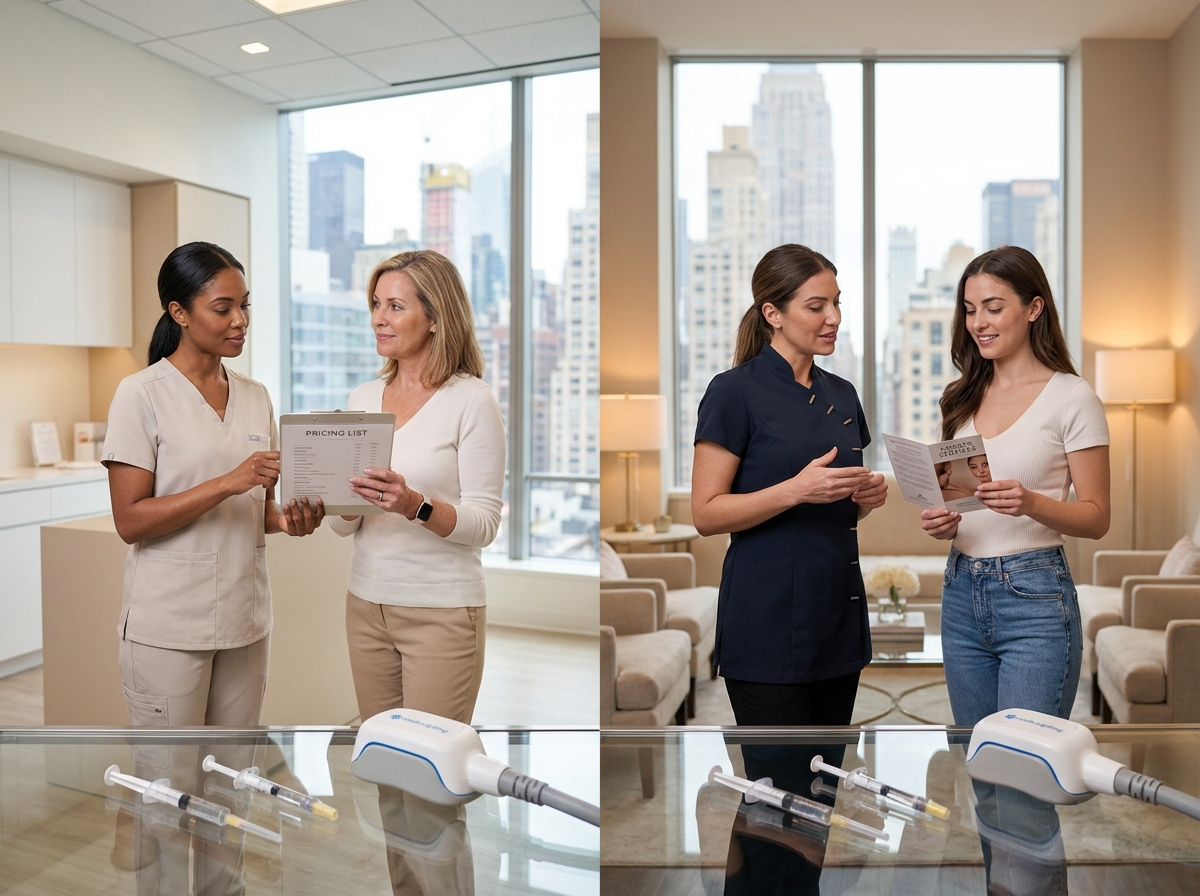
Booking a cosmetic procedure without comparing prices can cost you hundreds or thousands of dollars. This guide breaks down how clinics like LaserAway and Ideal Image set prices for Botox, fillers, CoolSculpting, and laser treatments, what to watch for in quotes, and practical tips to compare offers so you pay a fair price without sacrificing safety or results.
How Aesthetic Pricing Works
Understanding the price list at a medical spa can feel like decoding a secret language. Prices are not arbitrary; they are a complex calculation based on specific models, hard costs, and business strategies. The final price you pay is influenced by everything from the provider’s credentials to the clinic’s zip code.
The most common pricing model for neuromodulators like Botox, Dysport, or Xeomin is per unit. Think of a “unit” as a specific dose of the product. The number of units you need depends on the treatment area and the strength of your muscles. For example, treating forehead lines might require 20 units, while a subtle “lip flip” may only need 4 to 6 units. As of late 2025, the nationwide price range for neuromodulators is typically $12 to $25 per unit. A clinic in a major metropolitan area like New York or Los Angeles, with a board-certified dermatologist injecting, will likely charge closer to $25 per unit. In contrast, a medical spa in a suburban or rural setting with a registered nurse (RN) or physician assistant (PA) as the injector may offer prices closer to the $12 to $15 range.
For dermal fillers like Juvéderm and Restylane, the standard is pricing per syringe. Each syringe contains a set amount of product, usually 1.0ml. The cost is driven heavily by the specific filler used. Standard hyaluronic acid fillers for lips or smile lines generally cost between $700 and $1,200 per syringe. More robust fillers designed for structural support, like Juvéderm Voluma for cheeks or Sculptra for collagen stimulation, are more expensive, ranging from $900 to over $1,500 per syringe. The price reflects not just the cost of the product itself, but the advanced skill and anatomical knowledge required to inject it safely and effectively.
Body contouring treatments, such as CoolSculpting, follow a different model. Pricing is typically per cycle or per applicator. A “cycle” refers to one application of the device to a specific area. To treat the abdomen, for instance, you might need two to four cycles. The average cost per cycle in the U.S. is between $600 and $900. This high price point is directly related to the cost of the technology. The CoolSculpting machine itself is a significant capital investment for a clinic, and each cycle uses disposable components, adding to the overhead. Clinics often offer package deals, where the per-cycle cost decreases when you purchase multiple cycles at once.
Laser hair removal and other energy-based skin treatments like IPL photofacials are usually priced per session and sold in packages. The cost varies dramatically based on the size of the treatment area. A small area like the upper lip might cost $75 to $150 per session, while a large area like the full legs could be $300 to $600 per session. Since multiple treatments are required for permanent results, clinics almost always bundle these into packages of six or eight sessions, offering a discount over the single-session price. The type of laser technology also impacts cost; newer, more advanced devices that work on a wider range of skin and hair types represent a larger investment for the clinic, which is reflected in the treatment price.
Several other factors contribute to these price differences. The practitioner’s credentials are a major component. A treatment performed by a medical doctor (MD) will almost always cost more than the same treatment by an NP, PA, or RN. You are paying for their advanced training, experience, and diagnostic capabilities. Location also plays a huge role. High rent and operating costs in urban centers are passed on to the consumer.
The clinic’s business model is another key variable. National chains and franchises can often negotiate bulk discounts on products like Botox and fillers, but they also have massive marketing and administrative overheads to cover. Independent boutique clinics may have higher product costs but lower marketing expenses, focusing instead on a premium, personalized experience. Some clinics charge a consultation fee of $50 to $250 to ensure they are meeting with serious clients, though this fee is often applied as a credit toward any treatment you book. Others, particularly larger chains, offer free consultations as a primary marketing tool to attract new customers. Finally, the advertised price is rarely the final word. Promotions, first-time client discounts, and membership programs can significantly reduce the out-of-pocket cost. These programs, detailed on sites like the Ideal Image pricing page, are designed to build loyalty and make treatments more accessible through monthly payments or special member-only rates.
Direct Comparison: LaserAway vs. Ideal Image
When you step into the world of aesthetic chains, LaserAway and Ideal Image are the two giants you’ll encounter first. They operate like the Starbucks and Dunkin’ of the non-surgical world; they’re on every other corner in major cities, their branding is slick, and they promise consistent results. But their approaches to pricing, membership, and overall value proposition are surprisingly different. Let’s break down exactly what you can expect to pay at each.
At a glance, Ideal Image builds its pricing model around large, upfront packages and a signature “Lifetime Guarantee Membership,” particularly for laser hair removal. This is their core selling point. You pay a significant amount initially for a set of treatments, and in return, you get free touch-ups for life, only paying a small copay per visit. LaserAway, on the other hand, leans into a more flexible model with both a la carte options and smaller packages. They attract customers with aggressive new-client promotions and a celebrity-endorsed, high-energy brand image.
Let’s look at the numbers for common procedures.
Botox and Neuromodulators
Ideal Image often prices Botox by the “area” rather than the unit. A treatment for forehead lines might be quoted as a flat fee, which can obscure the true per-unit cost. Based on their package deals and membership pricing, the effective cost often lands between $13 to $16 per unit. They also offer an annual membership for Botox which provides a set number of units per year at a discounted rate, paid in monthly installments.
LaserAway is more direct, typically advertising a per-unit price. Their standard rate hovers around $14 to $17 per unit in major markets like Los Angeles or Miami. However, they are famous for new-client specials, frequently offering Botox for as low as $10 or $11 per unit, though this price is usually limited to a certain number of units.
Real-World Example (Chicago, IL): To treat forehead lines and the “11s” between the brows, a patient might need 40 units of Botox.
- At Ideal Image, this might be quoted as two “areas,” potentially costing around $600 ($15/unit).
- At LaserAway, a new client could potentially get the same treatment for $440 ($11/unit) with a promotion, while a returning client might pay closer to $640 ($16/unit).
Dermal Fillers
Both chains price fillers per syringe, with costs varying by the specific product (e.g., Juvéderm Ultra vs. Voluma).
At Ideal Image, a standard 1.0 mL syringe of a versatile filler like Juvéderm or Restylane typically costs between $750 and $950. They encourage buying multiple syringes through package deals, which can bring the per-syringe cost down slightly.
LaserAway’s pricing is very similar, with a single syringe of Juvéderm Ultra XC often priced between $700 and $900. They also offer multi-syringe discounts, which are a core part of their consultation upsell process.
CoolSculpting
Pricing for fat freezing is almost universally done per “cycle” or applicator.
Ideal Image heavily promotes multi-cycle packages. A single cycle might have a list price of $800, but they rarely sell just one. A typical package of 6-8 cycles for the abdomen and flanks could run from $3,500 to $5,000 after promotional discounts are applied.
LaserAway follows a similar structure. Their per-cycle cost is comparable, and they push packages like “Buy 4 Cycles, Get 2 Free.” The final out-of-pocket cost for a similar 6-cycle treatment plan would likely fall in the same $3,500 to $5,000 range. The real difference often comes down to the specific promotion running at the time of your consultation.
Laser Hair Removal
This is where the two chains diverge most significantly.
Ideal Image’s model is built on selling a lifetime of hair removal. A package for a large area like full legs could cost $5,000 to over $8,000. While the sticker shock is real, this price includes their Lifetime Guarantee. After your initial 9-16 sessions, you can come back for touch-ups forever, paying only a small copay (around $30-$50) per visit.
LaserAway sells packages of a finite number of sessions, usually 6 to 8. A package for full legs would be considerably cheaper upfront, perhaps in the $2,500 to $4,000 range. However, once those sessions are used, any future touch-ups required due to hormonal changes or new hair growth must be purchased separately at full price.
Both companies offer free consultations and rely heavily on financing options through third-party lenders like CareCredit and Ally Financial. It’s common to see offers for 0% APR for 12, 24, or even 36 months, which makes the large package prices more manageable for many customers. Be aware that their cancellation policies are strict. Once a package is purchased and financed, getting a refund is notoriously difficult. A missed or late-cancelled appointment typically results in forfeiting that session from your package, a direct financial loss.
The provider model also impacts cost and experience. Both chains primarily employ Registered Nurses and Nurse Practitioners to perform treatments, overseen by a remote medical director. This staffing model keeps labor costs down compared to a boutique clinic where a physician might perform the injections. While all providers are licensed, the level of experience can vary greatly from one nurse to another within the same location. This can lead to inconsistencies in results that aren’t always reflected in the standardized pricing.
How to Avoid Overpaying
Navigating the world of aesthetic pricing can feel like a maze, but you hold more power as a consumer than you might think. Getting the best value isn’t about finding the absolute cheapest option; it’s about paying a fair price for a safe, effective treatment from a qualified provider. Here’s how to ensure you’re not overpaying, whether you’re considering a national chain like LaserAway or a local boutique clinic.
Your Pre-Booking Checklist for Comparing Quotes
Treat your consultation like an interview where you are the one hiring. Go in prepared with a plan to gather all the necessary information. Use this checklist to compare apples to apples.
- Get an Itemized Quote in Writing. A total package price of $2,500 for “lips and cheeks” is too vague. You need a detailed breakdown to compare offers. A verbal quote is not enough; ask for it to be emailed or printed. This document is your leverage and your record.
- Confirm the Provider’s Credentials. Who, specifically, will be performing your procedure? A board-certified dermatologist or plastic surgeon’s time costs more than a registered nurse (RN) or physician assistant (PA). While experienced RNs and PAs are often excellent injectors, the price should reflect their credentials. A clinic charging top dollar for a non-physician injector is a potential red flag.
- Verify the Exact Product and Quantity. Don’t settle for “filler.” Are they quoting you for Juvéderm Voluma, which can cost upwards of $950 per syringe in late 2025, or Juvéderm Ultra, which might be closer to $750? For neurotoxins, is it Botox®, Dysport®, or Xeomin®? Ask for the exact number of units or syringes included in the quote. An unusually low price per syringe could indicate the product is diluted beyond the manufacturer’s recommendations, a dangerous practice that compromises results and safety.
- Clarify All Associated Fees. Ask about costs that might not be included in the initial quote. Are there separate fees for the initial consultation? What is the policy on follow-up appointments? If a touch-up is needed for Botox at the two-week mark, is it included or will you be charged for additional units? For treatments like CoolSculpting, confirm the price is per cycle or applicator, as treating one area like the abdomen may require two to four cycles.
Key Questions and Negotiation Scripts
During your consultation, your goal is to gather information and gently probe for flexibility. Confidence and politeness are your best tools.
Sample Script for an Itemized Quote
“Thank you for walking me through the treatment plan. The total cost is clear. For my records, could you please provide me with an itemized breakdown that lists the price per unit of Botox and the cost per syringe of filler we discussed? I’d like to see any other fees listed separately as well.”
Sample Script for Inquiring About Injector Tiers
“I understand that Dr. Evans oversees all treatments, which is reassuring. I’m comfortable having an experienced nurse injector perform my Botox treatment. Is there a difference in the per-unit price if I book with one of your senior RNs instead of the doctor?”
Many clinics have tiered pricing, even if they don’t advertise it. It’s always worth asking. The price difference can be significant, sometimes 15-25%, without a compromise in quality if the nurse is highly experienced.
Smart Negotiation Tactics
- Buy in Packages. This is the most common way to save. A single CoolSculpting cycle might cost $800, but a package of four could be priced at $2,600, bringing the per-cycle cost down to $650—a savings of $600. Similarly, clinics often offer a discount for purchasing multiple syringes of filler in one session.
- Ask About Off-Peak Pricing. Some clinics offer discounts for appointments on traditionally slow days, like a Tuesday morning. It never hurts to ask, “Do you have any flexibility on pricing for mid-week appointments?”
- Inquire About Price Matching. This is more common at large chains. If you have a written, itemized quote from a reputable local competitor for the same treatment (e.g., 40 units of Botox®), present it. They may not match it exactly, but it could open the door to a discount.
- Look for Promotional Credits. Ask if they have a referral program or if you can get a credit for leaving a review after your treatment. Some clinics offer a $50-$100 credit toward your next service for these actions.
Understanding the Price You’re Paying
A clinic’s price reflects more than just the cost of the product. A vial of Botox (100 units) may cost a clinic around $650, or $6.50 per unit. When they charge you $18 per unit, that markup covers the injector’s expertise and time (labor), the clinic’s overhead (rent in a prime location, insurance, staff salaries, marketing), and profit. A boutique clinic run by a renowned dermatologist may have a higher markup to cover their advanced expertise, while a chain like Ideal Image leverages bulk purchasing to lower its product cost, passing some savings to the consumer while still covering its significant marketing and operational expenses. A justified premium is tied to exceptional skill and experience, not just a fancy lobby.
Final Checks for Safety and Documentation
Before you commit, perform your due diligence.
- Verify Credentials. Check the provider’s license on your state’s medical board website. This is a public record and confirms they are in good standing.
- Check Device Safety. For devices like lasers or CoolSculpting, you can research the FDA’s Manufacturer and User Facility Device Experience (MAUDE) database. This allows you to see adverse events reported for specific devices, giving you a clearer picture of potential risks.
- Document Everything. Keep your written, itemized quote. After your consultation, send a brief follow-up email summarizing the key points: “Just to confirm, my appointment on [Date] is for 35 units of Botox at $18/unit and one syringe of Juvéderm Voluma for $950, for a total of $1,580. Please let me know if this is incorrect.” This creates a digital paper trail that can be invaluable if a price dispute arises later.
Common Questions and Practical Considerations
While the sections above cover pricing structures, patients often have specific questions regarding logistics, insurance, and technical details.
1. How many units of Botox do I really need for my forehead or crow’s feet?
This varies based on your muscle strength, anatomy, and desired outcome. However, there are common guidelines. For horizontal forehead lines, a typical dose is 10 to 20 units. For the “11s” between the brows (glabellar lines), it is often 20 to 25 units. For crow’s feet around the eyes, expect 10 to 15 units per side. These are just estimates. Your provider will determine the exact amount during your consultation. You can ask them to show you the manufacturer’s recommended dosing guidelines, which are provided by companies like Allergan, the maker of Botox.
2. Why does the price of one syringe of filler vary so much between brands like Juvéderm and Restylane?
Fillers are not all the same. Different brands and even different products within the same brand (like Juvéderm Voluma vs. Juvéderm Ultra) have unique formulations. They vary in their hyaluronic acid concentration, particle size, and how the molecules are cross-linked. These differences affect their thickness, lifting capacity, and how long they last. A thicker, longer-lasting filler designed for cheek augmentation costs more for the clinic to purchase than a softer filler for fine lip lines. That cost difference is passed on to you.
3. Are CoolSculpting results guaranteed? What if I don’t see a change?
No, results are not guaranteed. CoolSculpting is FDA-cleared for fat reduction, and most patients see noticeable results. However, individual outcomes depend on your body’s unique response to the treatment, your lifestyle, and the amount of fat in the target area. Reputable clinics will be upfront about this. They should take detailed before-and-after photos to track your progress. Some may offer a discounted follow-up session if results are minimal, but this is at the clinic’s discretion and should be clarified in writing before you start.
4. Will my health insurance cover any of these aesthetic treatments?
Almost certainly not. Procedures performed for purely cosmetic reasons, like wrinkle reduction, lip fillers, or non-surgical fat reduction, are considered elective. They are not medically necessary, so insurance companies do not cover them. The only rare exceptions might be Botox for medical conditions like chronic migraines or hyperhidrosis (excessive sweating), but this requires a specific medical diagnosis and pre-authorization from your insurer.
5. What are the risks with financing options like CareCredit?
Third-party financing is offered by many clinics and can be a useful tool, but it requires discipline. Many plans feature promotional periods, such as “0% interest if paid in full in 12 months.” Be very careful: if you do not pay off the entire balance within that promotional window, you will often be charged high interest retroactively from the original purchase date, not just on the remaining balance.
6. Do I have to tip my injector or aesthetician?
The etiquette can be confusing. For medical professionals like a doctor, physician assistant, or registered nurse performing injections, tipping is not expected or required. For an aesthetician performing a non-medical service like a facial, chemical peel, or laser hair removal, tipping is more common, similar to how you would at a salon (15-20% is standard). When in doubt, you can discreetly ask the front desk about the clinic’s policy.
Final Recommendations and Next Steps
You’ve navigated the complex world of aesthetic pricing, from the transparent menus of chains like Ideal Image to the customized quotes of local boutiques. Now it’s time to turn that knowledge into action. Making the right choice isn’t just about finding the lowest price; it’s about finding the best value for your safety, satisfaction, and budget. This final step is about creating a clear, methodical plan to book your procedure with confidence.
Think of the next two weeks as your final research phase. Your goal is to gather all the necessary information to make an informed decision without feeling rushed or pressured. Here is a prioritized checklist to guide you through the process.
- Research and Compare Published Prices. Start with a broad search online. Visit the websites of national chains like Ideal Image and LaserAway to get a baseline understanding of their package deals and membership pricing. Then, search for local boutique clinics in your area. While they may not list prices online, their websites often give you a feel for their specialties and brand.
- Confirm Provider Credentials and Experience. For any clinic you consider, identify the medical director and the practitioners who perform the procedures. Check their credentials on your state’s medical board website. Look for board-certified dermatologists, plastic surgeons, or registered nurses with specific training and years of experience in the exact procedure you want. Experience matters more than the name on the door.
- Request an Itemized Written Quote. Never proceed based on a verbal estimate. After a consultation, ask for a detailed, written quote that breaks down every cost. For Botox, it should specify the price per unit and the total number of units. For fillers, it should list the brand and cost per syringe. For CoolSculpting, it should detail the applicator type and number of cycles. This prevents surprise fees later.
- Check for Membership or Package Savings. Ask every provider about potential discounts. Chains are famous for their memberships and multi-session packages, which can significantly lower the per-treatment cost if you plan on regular upkeep. Boutiques may offer their own loyalty programs or package deals for complementary treatments. Don’t be afraid to ask, “Is this the best possible price, or are there any packages that could provide better value?”
- Read Verified Reviews and Before/After Photos. Look beyond the curated testimonials on a clinic’s website. Search for reviews on platforms like Google, Yelp, and RealSelf. Pay close attention to reviews that mention your specific procedure and practitioner. Scrutinize before-and-after photos. Look for consistency in lighting, angles, and patient expressions to ensure the results are being represented accurately.
- Schedule Consultations with At Least Two Providers. The most critical step is to consult in person. We strongly recommend booking one consultation with a major chain and another with a reputable local boutique. This allows you to directly compare their approach, pricing structure, and the rapport you feel with the provider. Pay attention to whether they listen to your goals or push a predetermined sales script.
Deciding between a chain and a boutique often comes down to your personal priorities.
Choose a chain clinic like LaserAway or Ideal Image if:
- Price predictability and promotions are your top priority. They often have standardized pricing and run frequent national sales.
- Geographic convenience is important. With numerous locations, you can often find one nearby or even get treatments while traveling.
- You are seeking a common, straightforward procedure like laser hair removal or a standard Botox treatment where technique is highly standardized.
Choose a boutique clinic if:
- You want a long-term relationship with a specific provider. You’ll likely see the same practitioner every time, allowing them to learn your unique anatomy and aesthetic goals.
- You need a highly customized treatment plan. Boutiques often excel at combining different modalities for nuanced results that a standardized package might not achieve.
- You value a more private, personalized environment over the high-volume feel of a larger chain.
For budgeting, it’s wise to plan carefully. As of December 2025, typical price ranges are $12 to $25 per unit for neurotoxins like Botox, $700 to $1,200 per syringe for hyaluronic acid fillers, and $600 to $1,000 per cycle for CoolSculpting. Always verify current pricing directly with clinics. We recommend setting aside an additional 10-15% of the total treatment cost as an emergency fund. This can cover unexpected needs like a small touch-up for asymmetry or the cost of managing a rare but possible complication.
Here are your concrete action items for the next 7–14 days:
- Create a comparison sheet. Use a simple spreadsheet or notebook to track clinics, provider names, quoted prices, and your personal impressions from each consultation.
- Book your two consultations. Get them on the calendar now. This is the single most effective way to move forward.
- Prepare your questions. Before you go, write down everything you want to know, including questions about their refund policy and how they handle touch-ups if the initial result isn’t perfect. Document the answers you receive.
By following these steps, you transform from a passive consumer into an empowered patient. Document everything, trust your gut feeling during consultations, and remember that the best price is the one that includes safety, expertise, and a result you love. Always confirm information with official sources and the clinics themselves before making a final decision.
Sources
- LaserAway vs Ideal Image: Key Differences and Services — Compare LaserAway and Ideal Image on services, technology, pricing, and customer reviews to find the best option for your aesthetic needs.
- Why is Laser Hair Removal So Expensive: Understanding the Costs — Ideal Image pricing for Face & Neck laser hair removal cost is $8,415, we charge only $499, a instant saving of $7,916! At our Medical Spa, we are just here to …
- Medical Spa Pricing for Treatments & Packages – Ideal Image — Find the cost of laser hair removal, CoolSculpting, Botox, and other top treatments at Ideal Image. Discover transparent pricing for expert-level care.
- How Much Does Laser Hair Removal Cost? – LaserAway — Laser hair removal is a personalized treatment, so pricing varies based on the areas you're treating and the number of sessions needed to achieve your goals …
- What Is The Best Hair Removal Method? – LaserAway — Electrolysis costs between $40 and $90 per treatment. It can take as many as 10 to 25 treatments to see permanent results. Electrolysis Pros. It is the only …
Legal Disclaimers & Brand Notices
The information provided in this article is for informational and educational purposes only and does not constitute medical advice, diagnosis, or treatment. Always seek the advice of a physician or other qualified health provider with any questions you may have regarding a medical condition or aesthetic procedure. Never disregard professional medical advice or delay in seeking it because of something you have read in this article.
All product names, logos, and brands mentioned in this text are the property of their respective owners. Use of these names, trademarks, and brands—including but not limited to Botox®, Dysport®, Juvéderm®, Restylane®, Sculptra®, and CoolSculpting®—is for identification purposes only and does not imply affiliation with, or endorsement by, the trademark holders.