This practical guide explains how men’s chest and back laser hair removal is priced in the United States and how to compare clinic costs for other non‑surgical services. Learn typical per‑session and package ranges, what drives price differences, and smart strategies to avoid overpaying when booking treatments like Botox, fillers, and CoolSculpting.
Understanding Pricing Models and Payment Structures
Understanding the financial commitment for laser hair removal requires looking past the introductory offers. Clinics use specific pricing models that can make direct comparisons difficult. You will typically encounter three main payment structures in 2025. The most common is the flat fee per area. This means you pay a set price for the chest or the back regardless of how long the session takes. A few clinics still charge by time, usually in 15-minute increments, or by pulse count. This model benefits men with sparse hair patches but penalizes those with dense growth that requires slower, more meticulous passes, making the final bill unpredictable.
The third and most popular model is the package deal. Clinics incentivize upfront payment for a series of treatments. A single session price is almost always higher than the per-session breakdown of a package; bundling typically lowers the per-visit cost by 20% to 30%. Memberships are also becoming standard. You pay a monthly fee that grants you one session per month or discounted rates on multiple services. This lowers the immediate out-of-pocket cost but binds you to a contract.
Typical Market Rates for 2025
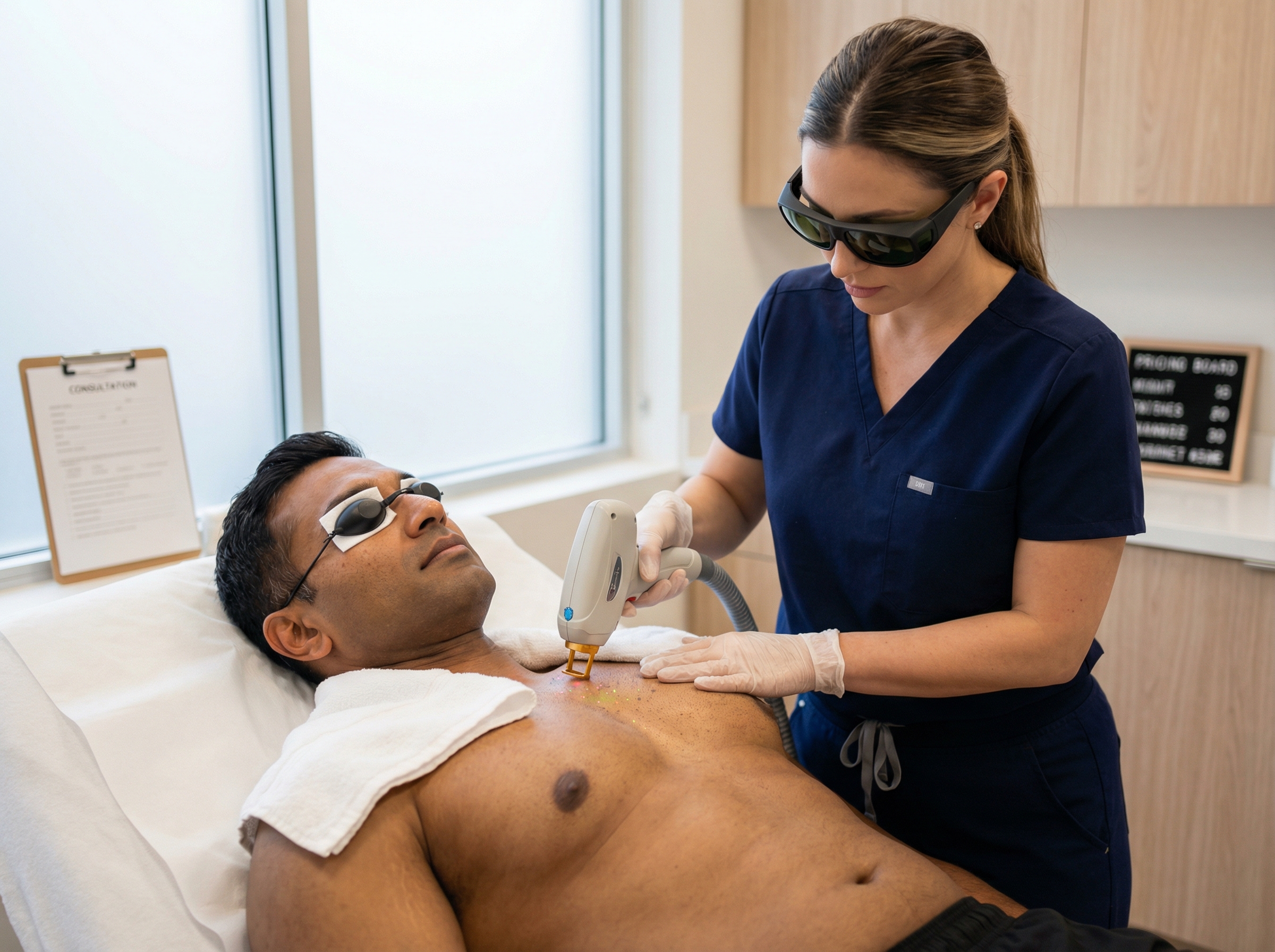
Current market data shows a wide range in pricing for male body areas. Market averages have shifted slightly upward this year due to equipment costs and inflation. The chest and the back are considered large treatment zones, and prices reflect the time required, the wear on the laser equipment, and the technology used. Newer devices that handle faster repetition rates often command higher prices because they reduce pain and treatment time.
Chest Pricing
- Per Session: Expect to pay between $100 and $400. The lower end usually reflects smaller medspas or older technology. The higher end represents premium dermatology practices.
- Package (6–8 Sessions): Total costs range from $600 to $2,000. This averages out to significant savings compared to paying as you go.
Back Pricing
- Per Session: This area is larger and more labor-intensive. Prices typically run from $150 to $500 per visit.
- Package (6–8 Sessions): A full course of treatment generally costs between $900 and $3,000.
These figures are averages. Laser Hair Removal Pricing Guide for 2025 indicates that full-back treatments can reach up to $1,200 per session in luxury markets, though that is an outlier.
Regional and Clinic Tier Variations
Geography plays a massive role in your final bill. Overhead costs in cities like New York, Los Angeles, and San Francisco drive prices up. A back treatment package in Manhattan might cost $3,500 while the same service in a suburb of Ohio could be $1,500. The type of facility matters just as much as the location.
Medspas usually offer the most competitive rates. They focus on volume and often employ estheticians or laser technicians. Dermatology clinics charge a premium. You are paying for medical oversight and often more advanced, medical-grade lasers. Plastic surgery practices tend to have the highest price points. They position laser services as a luxury add-on to surgical procedures.
Hidden Fees and Additional Costs
The sticker price rarely covers everything. You must budget for incidental costs that appear during the process. Consultations are often free, but some high-end clinics charge a booking fee that is applied to your first treatment. Numbing cream is a frequent hidden cost. If you have low pain tolerance, the clinic might charge an extra $30 to $50 per session for topical anesthetic.
Full Chest, Stomach, Back & Shoulders Laser Hair Removal for Men providers note that shaving fees are common. You must shave the area 24 hours before your appointment. If you arrive unshaven, clinics may charge $50 to $100 to prep the area for you because it cuts into their appointment time. Cancellation policies are also strict. Missing an appointment without 24 to 48 hours’ notice often results in a forfeiture of that session from your package or a fee ranging from $50 to the full cost of the visit.
Total Investment and Maintenance
Laser hair removal is not a one-time expense. It is a long-term reduction strategy. You will need 6 to 8 sessions spaced 4 to 8 weeks apart to see significant clearance. This means the initial treatment phase lasts about a year. After the main course, biology takes over. Hormones can stimulate new growth. Most men require maintenance sessions. These are typically needed once or twice a year. A single maintenance session costs the same as a standard per-session rate unless your clinic offers a loyalty discount.
Cost Scenarios
To help you budget, here are three realistic scenarios for a full back treatment plan in 2025.
The Budget Approach
You choose a chain medspa in a mid-sized city. You buy a 6-session package during a holiday sale.
Initial Package: $900
Numbing/Extras: $0 (You skip it)
Maintenance (Year 2): $150
Total 2-Year Cost: $1,050
The Average Approach
You visit a reputable independent clinic in a major metro area. You pay per session for the first two, then switch to a package.
First 2 Sessions: $700
Remaining Package: $1,500
Tips/Numbing: $200
Maintenance (Year 2): $350
Total 2-Year Cost: $2,750
The Premium Approach
You select a top dermatologist in NYC or LA. You prioritize comfort and speed.
8-Session Package: $3,200
Prescription Numbing: $400
Maintenance (Year 2): $600
Total 2-Year Cost: $4,200
Comparing these tiers helps you decide where to allocate your budget. How Much Does Laser Hair Removal Cost? suggests financing options are available for higher-end treatments, which can break these large sums into manageable monthly payments.
Cost Comparison Table
The following table outlines the estimated total costs for a full course of treatment (6-8 sessions) based on clinic tier. These figures represent the total cash outlay you should expect for a completed initial protocol.
| Clinic Tier | Chest Package Total | Back Package Total | Typical Extras |
|---|---|---|---|
| Budget / Chain | $600 – $900 | $900 – $1,400 | Numbing not included, strict cancellation fees |
| Mid-Range Medspa | $1,000 – $1,600 | $1,500 – $2,200 | Consultation included, occasional promos |
| Premium / Dermatology | $1,800 – $2,500 | $2,400 – $3,500 | Medical oversight, numbing often included |
Taxes are rarely included in the listed price. In states like New York, aesthetic services are subject to sales tax. That adds nearly 9% to your bill. Always ask for the “out the door” price before signing a contract.
How clinics set prices and smart ways to avoid overpaying
Understanding the final bill requires looking at what happens before you walk into the treatment room. The price tag on laser hair removal is rarely arbitrary. It reflects a combination of hardware costs, staff expertise, and operational overhead. A clinic using a top-tier machine in a high-rent district will always charge more than a basement operation with older technology.
The Technology Factor
The specific laser device is the biggest driver of cost. High-end systems like the Candela GentleMax Pro or the Lumenis Splendor X cost clinics upwards of $100,000 to purchase. These machines use dual wavelengths. They combine Alexandrite for lighter skin and Nd:YAG for darker skin. This versatility ensures safety and efficacy across all skin types.
Budget clinics often use older diode lasers or even IPL (Intense Pulsed Light) machines. IPL is cheaper to buy and operate but is generally less effective for permanent hair reduction on thick back or chest hair. It often requires more sessions to see results. You might pay less per visit but end up paying for twelve sessions instead of six. Safety is also a financial factor. Nd:YAG lasers are non-negotiable for men with darker skin tones to prevent burns and hyperpigmentation. Clinics that invest in this specific technology charge a premium for that safety profile.
Provider Credentials and Overhead
Who holds the handpiece changes the price. In some states, a medical doctor or a nurse practitioner must perform the procedure. Their hourly rate is significantly higher than that of a certified laser technician or aesthetician. You are paying for their medical license and the ability to handle complications immediately if they arise.
Geography plays a massive role. A clinic in downtown Los Angeles or Manhattan pays exorbitant rent and insurance premiums. These costs are passed directly to the consumer. A suburban medspa with lower overhead can offer the same treatment with the same machine for 20% less simply because their rent is cheaper.
Common Pricing Tactics
Marketing teams use specific strategies to make prices look attractive. You need to recognize these to avoid surprise costs.
- The Introductory Teaser. You might see an ad for a $99 back session. This is often a loss leader. The clinic loses money on the first visit to get you in the door. They will likely pressure you to sign a full package contract at a much higher rate immediately after your treatment.
- Bundled Packages. Clinics prefer you to pay upfront. A package of six sessions often lowers the per-visit cost by 20% or more. However, some clinics obscure the individual session price so you cannot calculate the true value.
- Time-Limited Promos. Sales reps create urgency by claiming a discount expires at the end of the month. This is almost always a sales tactic. The price is usually negotiable or the offer will return next month.
Comparison Checklist
Use this checklist when calling clinics to ensure you are comparing apples to apples. Do not rely on website prices alone as they are often outdated.
- Breakdown by Session. Ask for the single-session price and the package price. Calculate the exact savings.
- Laser Model. Ask specifically which machine they use. Verify it is a true laser and not IPL.
- Provider Details. Ask who will perform the treatment. Confirm if it is a nurse, a doctor, or a technician.
- Included Extras. Check if the price includes the consultation and the mandatory patch test. Some clinics charge $50 to $100 for these.
- Touch-up Policy. Ask if they offer discounted maintenance sessions after the main package ends.
- Refund Terms. Clarify what happens if you move or have a medical reaction after two sessions. Many packages are non-refundable.
Negotiation and Saving Strategies
You can lower your costs without compromising safety. Timing is everything. Clinics are often quieter in the summer months because people cannot laser tanned skin. Booking a package in July for a fall start date can sometimes yield a discount. Combining areas is another effective method. Treating the full back and chest together usually costs less than booking them separately. The clinic saves time on room turnover and passes some savings to you.
Ask about specific discounts. Many clinics offer reductions for military personnel, students, or first responders. Membership plans are becoming popular in 2025. You pay a monthly fee for discounted rates on all services. This works well if you plan to maintain your results long-term. Be cautious with third-party deal sites like Groupon. These deals can be legitimate but often come with strict restrictions or are used by struggling clinics with older equipment. Always call the clinic to verify their credentials before buying a voucher.
Benchmarking Value
It helps to compare laser hair removal costs against other aesthetic investments to understand the value proposition. Laser hair removal costs are often higher upfront but eliminate a daily chore.
Consider Botox. The typical price is $10 to $20 per unit. A full forehead and crow’s feet treatment runs between $200 and $1,000 every three to four months. That is a recurring lifetime cost. Dermal fillers cost $600 to $1,200 per syringe and last about a year. CoolSculpting for body contouring costs $600 to $1,500 per cycle, with full treatment packages often reaching $2,000 to $4,000. Compared to these, a permanent reduction in back hair for a total of $2,000 to $3,000 is a finite investment with a permanent payoff.
Cheaper is not always better when lasers are involved. A bargain price is not a deal if the technician burns your skin or if the hair grows back in six months because the energy settings were too low. Paying a higher rate for a reputable clinic with medical oversight and the latest Nd:YAG or Alexandrite technology is often the smarter financial move in the long run.
Frequently Asked Questions
You now understand the mechanics behind the pricing. The machines, the overhead, and the expertise all play a role in that final number on the invoice. But knowing why a session costs $300 doesn’t answer the practical questions keeping you up at night. You probably want to know if it hurts, if it actually works forever, and how to spot a bad deal before you hand over your credit card.
Here are the honest answers to the most common questions men ask about back and chest laser hair removal.
Practical Questions About Treatment and Results
How many sessions will I really need?
Most clinics suggest six to eight sessions. This is the standard for a reason. Hair grows in cycles. The laser can only target the hair follicle when it is in the active growth phase. At any given time only a portion of your back or chest hair is in that phase. You need multiple sessions spaced 4 to 8 weeks apart to catch every hair in the right cycle. Men often have higher testosterone levels which can stimulate new growth. You might need closer to eight or ten sessions for a truly smooth back compared to someone treating their legs.
Is laser hair removal actually permanent?
The FDA classifies it as permanent hair reduction. It is not total removal. You can expect a 70% to 90% reduction in hair density. The hair that remains will be finer and lighter. You will likely need maintenance. Most men go back once a year for a touch-up session to keep the area smooth. If a clinic promises 100% removal for life with zero maintenance they are lying to you.
Does it hurt?
It feels like a rubber band snapping against your skin. The chest is often more sensitive than the back. Modern machines have cooling mechanisms that blast cold air or use a chilled tip to numb the skin instantly. This helps a lot. You can also ask for a prescription numbing cream if you have low pain tolerance. It adds time to the appointment but makes the process much easier.
Can I get laser if I have tanned or dark skin?
Yes but the equipment matters. Older lasers like the Alexandrite are great for light skin with dark hair but can burn darker skin. If you have a tan or naturally darker skin you need a clinic that uses an Nd:YAG laser. This wavelength bypasses the skin pigment and targets the hair follicle directly. Transparent pricing for every area often reflects the specific technology used so always ask what machine they will use on you.
What happens if I have tattoos on my back or chest?
You cannot laser over a tattoo. The laser is attracted to pigment. It cannot distinguish between hair pigment and tattoo ink. It will burn the tattoo and potentially cause blistering or scarring. The technician must work around the tattoo. You will have to shave the tattooed area yourself or use other hair removal methods for that specific spot.
Are there medical or age restrictions?
There is no strict upper age limit but gray or white hair does not respond to laser. The laser needs dark pigment in the hair root to work. If your back hair is already turning gray laser is a waste of money. Regarding medical issues you should avoid laser if you are taking photosensitive medications like Accutane. You generally need to be off Accutane for six months before treatment.
Financial and Logistical Questions
Do clinics charge for consultations?
Most reputable clinics offer free consultations. They want to get you in the door. Some high-end dermatology practices might charge a fee of $50 to $100 to reserve the time. This fee is usually applied as a credit toward your first treatment. If a medspa demands a high non-refundable consultation fee without applying it to the service be cautious.
Single sessions vs. packages: Which is better?
Packages almost always offer a better per-session rate. You might pay $400 for a single back session but get a package of six for $2,000. That drops the price to roughly $333 per visit. Laser hair removal pricing guides often highlight these bulk savings. However packages lock you in. If the clinic has bad service or goes out of business you might lose that money. Buying a single session first to test the waters is a smart move even if it costs a little more upfront.
How much do touch-ups cost later?
Maintenance is cheaper than the initial treatment. Once you finish your main package you might need one session a year. Many clinics offer a “lifetime guarantee” membership or a significant discount for touch-ups. Expect to pay between $50 and $150 for a quick touch-up session on the back or chest depending on how much regrowth you have.
Are Groupon or deal sites safe?
They can be safe but you must read the fine print. Low prices often mean older equipment or extremely limited appointment availability. A deal might be for a “small area” only while defining the chest as a “large area” requiring an upcharge. Call the clinic before buying the voucher. Ask them specifically about the machine they use and if there are blackout dates for deal holders.
What about refunds?
Refunds are rare in this industry. Most clinics operate on a “no cash back” policy once you start treatment. If you have a medical reaction they might offer store credit for other services. Always read the cancellation policy before signing a contract for a large package.
Benchmarking Value: Laser vs. Other Aesthetics
It helps to compare laser costs against other common aesthetic procedures to understand the value. Laser hair removal is an upfront investment with a long-term payoff. Other treatments require constant spending to maintain results.
| Procedure | Typical Cost (USA) | Frequency |
|---|---|---|
| Botox / Dysport | $10–$20 per unit ($200–$600 per area) | Every 3–4 months |
| Dermal Fillers | $600–$1,200 per syringe | Every 9–18 months |
| CoolSculpting | $600–$1,500 per cycle ($2k–$4k total) | 1–2 sessions usually permanent |
| Laser Hair Removal (Back) | $250–$500 per session ($1.5k–$3k total) | 6–8 sessions then yearly touch-up |
As you can see the total cost of a full laser package is comparable to one or two rounds of CoolSculpting or a year of Botox maintenance. The difference is that after your laser package is done your spending drops to almost zero.
Scripts to Use During Your Consultation
You need to be direct when you speak with a provider. Use these scripts to get clear answers and avoid hidden fees.
To check for hidden costs:
“Does this quote include the numbing cream and post-care lotion or are those separate charges?”
To verify equipment quality:
“What specific laser model do you use for my skin type? Is it an IPL machine or a true diode/alexandrite laser?”
To understand the guarantee:
“If I still have significant hair growth after my sixth session what is the price for additional treatments? Is it the full single-session price or a reduced touch-up rate?”
To clarify the package terms:
“If I move or have a medical issue that prevents me from finishing the package can I get a refund for the unused sessions?”
Red Flags: When to Walk Away
Not every clinic deserves your business. If you see these warning signs keep your wallet in your pocket.
- No Patch Test: A reputable provider will always test the laser on a small spot of your skin to check for adverse reactions before doing a full treatment. If they want to zap your whole back on day one without testing run away.
- Guaranteed Permanent Removal: No laser can legally or scientifically promise 100% permanent removal of every single hair. This is a false marketing claim.
- Vague Pricing: If they won’t give you a price list or a written quote without a high-pressure sales pitch it is a bad sign. You should be able to see how much laser hair removal costs clearly.
- Unlicensed Operators: In many states a medical director must oversee the facility. If the person firing the laser has no certification or cannot explain the safety protocols do not let them touch you.
- Dirty Facility: This is a medical procedure. The room should be spotless. If the goggles look dirty or the paper on the table hasn’t been changed leave immediately.
Final takeaways and next steps
You have read the pricing breakdowns and the science behind the lasers. You understand that removing hair from the back and chest is a significant financial commitment. Now you need to make a booking without regretting it three months later. The goal is to find a provider who balances safety with a price that makes sense for your budget.
Summary of costs and critical factors
We have established that pricing varies wildly based on geography and clinic reputation. In late 2025 you should expect to pay between $200 and $600 per session for large areas like the full back or chest. Some premium medspas in major metropolitan hubs will charge upwards of $800 per visit. If you buy a package of six or eight sessions the per-visit cost usually drops by 15% to 20%.
The price tag depends heavily on the technology used. Clinics using older IPL machines often charge less. Clinics using true medical-grade lasers like the Candela GentleMax Pro or the Lutronic Clarity II generally charge more. You are paying for the efficacy and speed of those newer devices. A cheaper session that requires twelve visits to see results is actually more expensive than a pricier session that finishes the job in six visits.
Safety is the other major cost factor. A board-certified dermatologist or a nurse practitioner with a decade of experience costs more than a technician who finished a weekend course last month. You are paying for their ability to handle your skin type correctly and manage any adverse reactions. Never compromise on the operator’s credentials to save fifty dollars.
Your step-by-step action plan
Do not just walk into the nearest clinic and hand over your credit card. Follow this specific sequence to vet providers and secure a fair deal.
1. Research beyond the homepage
Start by identifying three clinics in your area that specialize in male hair removal. Look for reviews on third-party sites like Google Maps or RealSelf rather than the testimonials on their own website. Look specifically for reviews from men who had back or chest treatments. Pay attention to comments about long-term results and staff professionalism.
2. Request a written quote
Call each clinic. Ask for a detailed quote sent via email. Verbal quotes are often forgotten or changed once you arrive at the front desk. Having the numbers in writing gives you leverage if the price suddenly jumps during your consultation.
3. Demand a patch test
This is non-negotiable. A reputable clinic will perform a patch test on a small area of your back or chest to see how your skin reacts to the laser settings. If a clinic refuses a patch test or tries to rush you into a full session immediately you should walk away. This test prevents burns and ensures the laser is effective on your specific hair type.
4. Calculate the effective cost
Clinics structure packages differently. You need to do the math to compare apples to apples. Divide the total package price by the number of sessions to get the real per-visit cost. Ask if the package includes maintenance sessions. Some clinics offer a lifetime guarantee where touch-ups are significantly discounted after you complete your initial package.
For a broader look at national averages and financing options you can check resources like the CareCredit pricing guide which tracks these trends across the U.S.
5. Schedule strategically
Clinics are often quieter in the winter months. You might find more flexibility with booking or even seasonal promotions during January or February. Since you cannot expose the treated area to the sun for weeks before and after treatment winter is logically the best time to start anyway.
Create your comparison table
Use a simple grid to compare your top three choices side by side. This visual aid helps you see where the value lies. Fill this out for every clinic you visit.
| Comparison Point | Clinic A | Clinic B | Clinic C |
|---|---|---|---|
| Laser Device Model | (e.g. Candela GentleMax) | (e.g. Alma Soprano) | (e.g. Generic IPL) |
| Single Session Price | $450 | $350 | $200 |
| Package Price (6 sessions) | $2,200 | $1,800 | $1,000 |
| Effective Cost Per Session | $366 | $300 | $166 |
| Touch-up Policy | 50% off future visits | Full price | Not specified |
| Operator Credential | Registered Nurse | Laser Technician | Esthetician |
Seeing the data this way highlights that Clinic C might be cheap but uses inferior technology. Clinic A costs more upfront but offers better long-term value through discounted touch-ups and a medical-grade device.
Timing and preparation
Since we are in late 2025, you are in the prime window to begin. A full course of treatment takes about six to nine months because sessions are spaced four to six weeks apart. Starting now means you will be finished by early summer 2026. If you wait until April to start you will have to pause treatment during the summer months to avoid sun exposure risks.
Prepare for your first appointment by shaving the area 24 hours in advance. Do not wax or pluck. The laser needs the hair root to be present in the follicle to work. Avoid heavy workouts or saunas for 24 hours after your session to prevent irritation. Large areas like the back can feel like a mild sunburn for a day or two so plan your wardrobe accordingly. Loose cotton shirts are your friend.
Remember that full back or chest treatments are a medical procedure. Treat them with the same seriousness you would any other skin treatment. Prioritize the skill of the provider and the quality of the laser over the lowest possible price. Your skin is permanent. A bad discount deal is not worth the risk of burns or ineffective results.
Sources
- Male Laser Hair Removal Cost | Transparent Pricing for Every Area — Small areas like underarms or neckline start around $60 per session. Larger zones like the chest or back range from $100–$250 per session. We'll …
- Laser Hair Removal Pricing Guide for 2025 – Kintsu MedSpa — Smaller areas like the upper back or shoulders cost around $300 to $800 per session. A full-back or chest treatment can range from $500 to $1,200 per session.
- Laser hair removal cost 2025: Ultimate Value – Athena Plastic Surgery — Large areas like full legs, back, chest, or Brazilian treatments are the biggest investment at $200 to $600 per session. Full leg treatments average $397 …
- How Much Does Laser Hair Removal Cost? – CareCredit — The average cost in the U.S. for laser hair removal can range between $207 and $913, depending on a variety of factors. Learn more.
- Full Chest, Stomach, Back & Shoulders Laser Hair Removal for Men … — Should you need assistance with shaving at the time of your appointment, a $50-$100 fee will be assessed. We also recommend avoiding sun exposure for 4 weeks …
- How Much Does Laser Hair Removal Cost? USA Pricing Guide 2025 — In 2025, the ASPS reported that the average price of laser hair removal and other laser treatments is $697. While ASPS doesn't release its …
- Laser Hair Removal Cost – Satori Laser — Laser hair removal ; UPPER NECK UPPER NECK, $99 · $267 ; LOWER NECK LOWER NECK, $99 · $267 ; FULL NECK FULL NECK, $109 · $294 ; BACK of NECK BACK of NECK, $119 …
- Men's Chest & Abdomen Laser Hair Removal — At only $54.75 per treatment, this starter package is the perfect way to try laser. After your purchase, call 800-559-9138 to kickstart your journey to a smooth …
Legal Disclaimers & Brand Notices
The information provided in this article is for educational and informational purposes only and does not constitute professional medical advice, diagnosis, or treatment. Always seek the advice of a physician or other qualified health provider with any questions you may have regarding a medical condition or specific aesthetic procedures. Never disregard professional medical advice or delay in seeking it because of something you have read in this content.
All product names, logos, and brands are property of their respective owners. All company, product, and service names used in this article, including but not limited to Botox, Dysport, and CoolSculpting, are for identification purposes only. Use of these names, logos, and brands does not imply endorsement or affiliation.