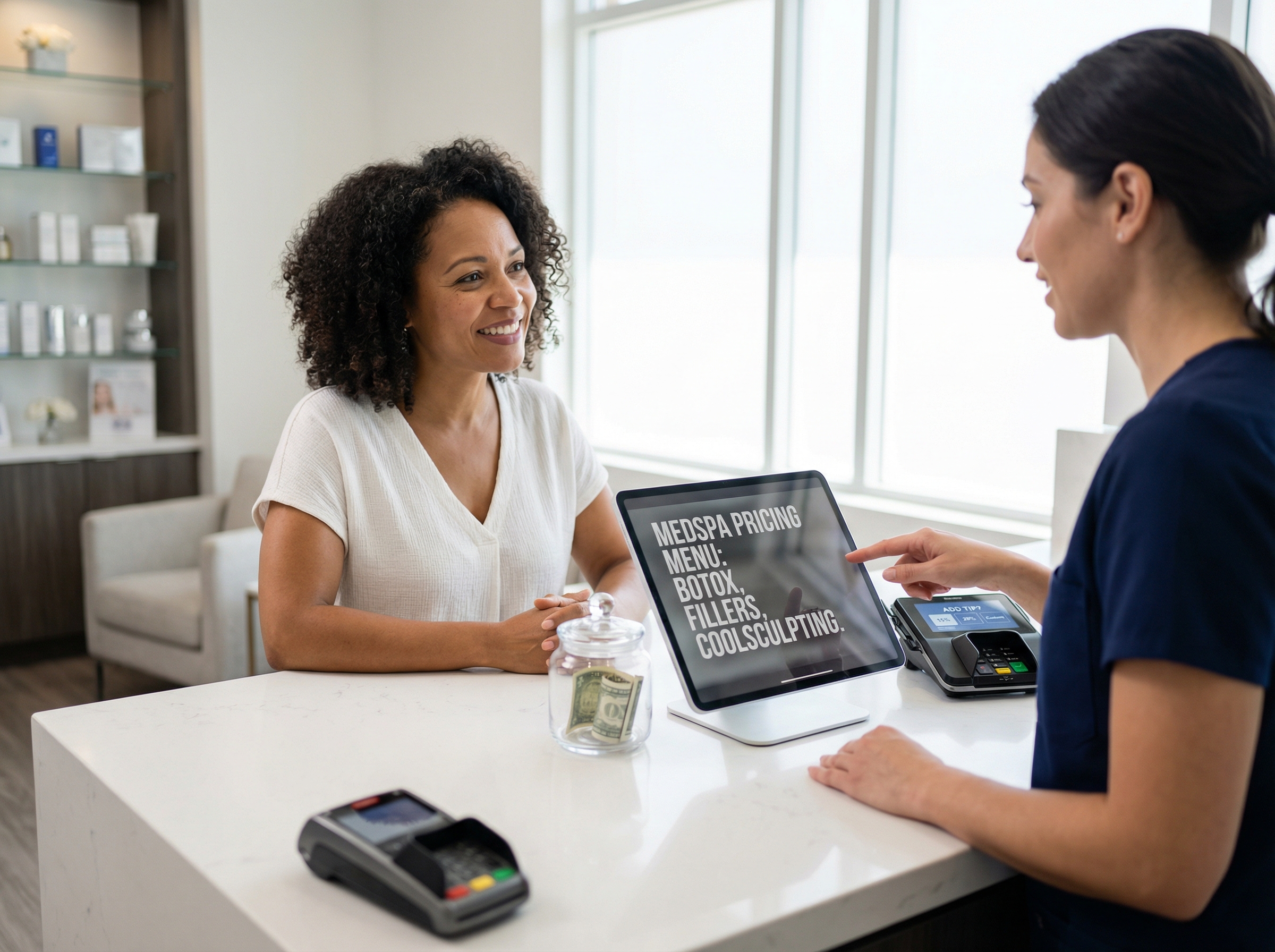
Deciding whether to tip at a medspa can be confusing — medical and cosmetic services blur typical service-industry rules. This article explains whether tipping is required, customary amounts for injectables, laser and body-contouring treatments, and how clinics price Botox, fillers and CoolSculpting. You’ll also get practical steps to compare aesthetic clinic prices and avoid overpaying before you book.
Understanding Tipping at MedSpas
The Gray Area of MedSpa Tipping
Walking into a medical spa in late 2025 feels different than walking into a hair salon or a dermatologist’s office. You are in a space that blurs the line between luxury service and clinical treatment. This creates immediate confusion about payment etiquette. You might wonder if you should hand cash to the nurse who just injected your lips or if that is considered insulting. The rules here are not as clear as they are in a restaurant.
Tipping in a medspa is almost always discretionary. It is rarely a hard requirement. This differs from the hospitality industry where servers rely on tips to make a living wage. Medspa staff typically earn a higher hourly rate, a salary, or a commission on the services they perform. However, the culture has shifted. Many private clinics now have software that flips a screen around to ask for a gratuity at checkout. This pressure can make you feel obligated even when you are paying hundreds of dollars for a medical treatment.
Distinguishing Tips from Mandatory Fees
You need to read your receipt carefully before you take out your wallet. Transparency has improved significantly this year, but billing terminology can still be tricky. You might see line items that look like tips but are actually operational costs.
A Service Charge is a mandatory fee. The business automatically adds this to your bill. It often ranges from 5% to 20% depending on the clinic policy. This money might go to the staff as a commission, or it might go straight to the business revenue. You do not need to tip on top of a mandatory service charge unless you really want to. Always ask the front desk if this fee includes gratuity.
A Facility Fee is different. This covers the overhead of the room, the medical supplies, and the sterilization equipment. It is common in higher-end clinics or those attached to surgical centers. This fee never goes to the provider as a gratuity. It is strictly for the house.
Gratuity is the optional amount you choose to give. It is a reward for the personal attention and care you received. If you see a blank line for gratuity on a receipt that already has a service charge, ask the front desk where that service charge goes. You have the right to know if you are double-tipping.
Medical Providers vs. Aesthetic Staff
The most important factor in your tipping decision is the license held by the person touching your face. The industry divides staff into medical and non-medical categories. This distinction dictates the etiquette.
Medical Providers (MD, DO, NP, PA): You generally do not tip doctors. It is not standard practice to tip a surgeon or a dermatologist. Many physicians feel it devalues their medical training. It can even cross ethical lines. Nurse Practitioners (NPs) and Physician Assistants (PAs) fall into a gray area. They are licensed medical professionals. In a purely clinical setting, you would not tip them. In a medspa setting where they are performing cosmetic work, some patients do offer tips. However, it is never expected for these high-level providers.
Nurses (RN): Registered Nurses often perform injections or laser treatments. Tipping them is becoming more common in 2025, but it remains optional. If an RN spends an hour with you and provides exceptional care, a modest tip is a nice gesture. It is not a requirement.
Aestheticians and Technicians: These professionals rely more heavily on gratuities. They perform non-invasive services like facials, chemical peels, and body contouring. The compensation structure for aestheticians often assumes they will receive tips. The standard etiquette here mirrors a day spa. Tipping is expected and appreciated.
Legal and Ethical Considerations
The rules change depending on where you live. State medical boards oversee these facilities. They have strict regulations about fee-splitting and kickbacks. In some states, it is illegal for a medical professional to accept a tip because it could be viewed as a financial inducement that influences their medical judgment. A doctor should recommend a treatment because it is safe for you, not because they hope for a bigger cash bonus.
Clinic owners are aware of these risks. That is why you will see specific policies in place. Some clinics enforce a strict “no tipping” rule for all medical services to stay compliant and maintain a clinical atmosphere. They might view themselves strictly as a medical office. Other clinics operate more like luxury spas and encourage tipping for everyone. You might see small envelopes at the front desk or a tip jar for the support staff.
You should respect the policy. If a provider refuses a tip, do not push it. They are likely protecting their license. If you feel strongly about their service, a positive review online or a thank-you card is a safe and valuable alternative.
Why Patients Choose to Tip
People tip in medspas for personal reasons rather than obligation. You might tip because the provider managed your pain exceptionally well during an uncomfortable laser session. You might tip because they squeezed you into the schedule at the last minute. The emotional connection matters. Aesthetic treatments are vulnerable experiences. When a provider makes you feel safe and confident, you naturally want to reward that.
There are times when tipping is inappropriate. You should not tip for a quick follow-up appointment to check a bruise. You should not tip if the procedure was purely medical, such as treating hyperhidrosis (excessive sweating) or a migraine protocol, even if it involved Botox. You should never feel pressured to tip if the results were unsatisfactory or if the provider rushed you.
Real-World Scenarios
Here is how these rules apply to three common appointments you might book.
The Injectable Appointment
You book an appointment for Botox and lip filler. The provider is a Registered Nurse (RN). She spends 45 minutes with you. She applies numbing cream and waits for it to work. She talks you through your anxiety. The bill comes to $600.
The Verdict: A tip is optional. If you choose to tip, a flat amount of $20 to $50 is appropriate to show appreciation for her bedside manner. You do not need to calculate 20% of the medical product cost.
The CoolSculpting Session
You are coming in for a body contouring treatment. A certified technician sets up the machine. The treatment takes two hours. The technician ensures you are comfortable with pillows, brings you water, and checks on you every 15 minutes.
The Verdict: This is a service-heavy appointment. The technician is likely not a medical doctor. A tip is appropriate here. You might leave $20 to $40 per hour of service, or a flat $50 for the session.
The Medical Facial
You schedule a HydraFacial or a chemical peel. The provider is a licensed aesthetician. The service focuses on skin health but includes massage and relaxation elements.
The Verdict: Treat this exactly like a regular spa visit. The aesthetician relies on tips. A gratuity of 15% to 20% of the service price is standard and expected.
Summary for Search Engines:
Learn the rules of medspa tipping and tipping etiquette for 2025. We explain when to tip for Botox and how to compare aesthetic clinic prices without overpaying.
How Much to Tip and How to Compare Prices Before Booking
Figuring out the final bill at a medspa is harder than it looks. You see the service price, but then there are facility fees, potential taxes, and the big question of the gratuity. Since medical aesthetics blend clinical treatments with spa-like luxury, the rules for tipping are rarely written on the wall.
You need a clear strategy to handle the payment terminal without panicking. We will break down exactly what the market looks like right now in late 2025 and how to calculate a fair tip without overspending.
Real-World Tipping Guidelines for 2025
The old rule of a flat 20 percent does not always apply here. Medspa treatments vary from fifty dollars to several thousand. Tipping percentages usually drop as the price of the medical procedure rises.
Here is how the numbers break down by service type based on current U.S. standards.
| Service Type | Typical Tip Range | Suggested Approach |
|---|---|---|
| Medical Facials & Peels | 15% to 20% | Treat this like a standard spa service. If the bill is $200, tip $30 to $40. |
| Laser Hair Removal | 10% to 20% | For single sessions, tip on the percentage. For expensive packages, a flat $20 to $50 per session is common. |
| Botox & Dysport | $20 to $50 flat or 10% | Many patients do not tip on medicine. If you love the service, a flat cash tip is better than a percentage of the drug cost. |
| Dermal Fillers | $20 to $100 flat | Since syringes cost $600 to $900 each, a 20% tip is excessive. A flat gesture of gratitude works best here. |
| CoolSculpting | $20 to $50 per cycle | The machine does most of the work. Tip the technician for their time and comfort management. |
Payment Logistics
Cash is always the preferred method for tipping because it goes directly to the provider immediately. If you do not carry cash, asking to add a tip to your credit card is standard. Most modern clinic apps and booking systems have a gratuity screen at checkout. However, some medical-specific software disables this feature to avoid “tipping pressure.” If the option isn’t on the screen, the clinic likely doesn’t accept credit card tips, so having a small amount of cash on hand is a safe backup.
How to Compare Prices and Avoid Overpaying
Pricing in 2025 is opaque. Clinics often list “starting at” prices that bear little resemblance to the final bill. To compare aesthetic clinic prices effectively, you need to ask the right questions before you book the appointment.
Request an Itemized Quote
Never settle for a ballpark estimate over the phone. Ask for a breakdown that separates the cost of the product from the service fee. For Botox, ask specifically for the price per unit. For fillers, ask for the price per syringe.
Check the Product Brand
Not all neurotoxins are Botox brand. Dysport, Xeomin, and Jeuveau are competitors that often cost less. If a clinic offers a very low price per unit, confirm which brand they use. Paying premium prices for a cheaper alternative is a common way people overpay.
Verify Provider Experience
You are paying for the hand holding the needle. A master injector with 10 years of experience charges more than a novice. If you are comparing two clinics and one is significantly cheaper, check if the injector is a trainee or a seasoned pro.
Typical U.S. Price Ranges (2025 Estimates)
Knowing the national averages helps you spot price gouging or suspicious discounts. These are approximate ranges for major metropolitan areas.
- Botox/Neurotoxin: $12 to $18 per unit. Premium cities like NYC or LA may range from $18 to $25 per unit.
- Dermal Fillers (HA): $600 to $900 per syringe. Specialized fillers like Voluma or Sculptra often run higher, from $800 to $1,200.
- CoolSculpting: $600 to $800 per cycle (small applicator). Large applicators cost double.
- Laser Facials (e.g., IPL, Fraxel): $300 to $800 per session depending on intensity.
Calculating Your Total Cost
Let us look at two examples to see how the math works when you combine price and tipping.
Example A: Botox Treatment
You receive 30 units of Botox for your forehead and frown lines.
Price: 30 units x $14/unit = $420.
Tip Decision: Since this is a medical injectable, you decide on a flat tip rather than a percentage.
Tip Amount: $30.
Total: $450.
Example B: Medical Facial
You get a custom facial with extractions and a light peel.
Price: $225.
Tip Decision: This is a service-heavy aesthetic treatment, so you apply the 20% rule.
Tip Amount: $45.
Total: $270.
Pre-Booking Checklist to Avoid Overpaying
Use this list when calling clinics to ensure you get the best value without hidden surprises.
- Check the gratuity policy online: Look at the FAQ section of the clinic website before you call to see if they have a “no-tipping” policy.
- Ask for the exact price per unit: Get the specific rate for neurotoxins and per syringe for fillers.
- Confirm consultation fees: Ask if there is a fee and if it applies toward the treatment cost.
- Clarify follow-up costs: Ask if touch-up appointments are included or billed separately.
- Inquire about memberships: Check if they offer membership pricing or package discounts for buying multiple sessions upfront.
- Verify the brand: Confirm the specific brand of product being used (e.g., Botox vs. Dysport).
- Check rewards programs: Ask if they participate in manufacturer rewards programs like Allē or Aspire for points and discounts.
By understanding the baseline costs and the tipping culture, you can walk into your appointment focused on your results rather than worrying about the bill. Do you tip for Botox at a med spa? The answer is ultimately up to you, but knowing the market standards keeps you from overpaying out of guilt.
Summary
Navigating medspa costs requires checking per-unit rates and understanding that tipping is standard for aestheticians but optional for medical injectors. Compare aesthetic clinic prices by verifying provider credentials and product brands to avoid overpaying medspa bills.
Common Tipping Scenarios and Edge Cases
We have crunched the numbers on per-unit costs and looked at how to spot a fair price for fillers. But even after you do the math and book the appointment, specific situations can still be awkward. Here are the most common questions regarding specific payment scenarios in late 2025.
Should I tip if I got a discount, membership price, or package deal?
The short answer: Yes, if you are tipping, base it on the original value of the service, not the discounted price.
If you bought a package of six laser sessions or have a membership that gives you 20% off, the provider still did the same amount of work. Tipping on the lower amount shortchanges them if gratuity is part of their expected compensation for that specific service (like a facial).
Practical recommendation: Check the “menu price” of the treatment before you go in so you can calculate a fair tip based on the real value, not what you paid that day.
How do I tip after a treatment if I didn’t bring cash?
The short answer: Ask if they have a digital option like Venmo or a clinic app.
Cash is becoming rare. Many providers in 2025 have a business QR code at the desk for this exact reason. If they don’t have a digital option and you can’t add it to the card, it is okay to skip it this time.
Practical recommendation: Simply say, “I didn’t bring cash, can I add this to the bill?” If the answer is no, simply thank them verbally and bring cash next time if you return.
What if I’m unhappy with the result — do I still tip?
The short answer: Absolutely not.
Tipping is for satisfaction. If you have a bad reaction, the asymmetry is off, or the service was rude, you are under no obligation to pay extra. In fact, tipping might signal that you were happy with the service, which confuses the situation if you later call to complain.
Practical recommendation: If you are unhappy, skip the tip and ask to speak to the practice manager privately before you leave.
Do I tip for consultations that are free?
The short answer: No, never.
A consultation is a sales opportunity for the clinic. They are assessing your face to recommend products and services. It is a business meeting, not a service delivery.
Practical recommendation: Just be on time and be respectful. That is all the “payment” a free consultation requires.
When is a follow-up or touch-up appointment eligible for a tip?
The short answer: Only if they perform a significant new service or spend a lot of extra time with you.
If you are going in for a two-week Botox check-up and they add two units, or if they are just checking a bruise, no tip is needed. If they end up doing a full facial or adding a syringe of filler you hadn’t planned on, then standard tipping rules apply.
Practical recommendation: Treat the follow-up as part of the original medical package. No money needs to change hands unless you buy something new.
Are tips taxable income for providers?
The short answer: Yes, 100% of tips are taxable income that providers must report.
Whether you pay in cash, Venmo, or credit card, the provider is legally required to report that money. Medspa professionals shouldn’t accept tips under the table if they want to stay compliant with tax laws and clinic policies.
Practical recommendation: Do not worry about the tax implications; that is on the provider. Just pay how it is most convenient for you.
Final Recommendations
Navigating the final bill at a medspa can feel awkward, but it does not have to be. The main thing to remember is that tipping is entirely discretionary and never mandatory for medical procedures. While a 15 to 20 percent gratuity is standard for aesthetician services like facials, medical treatments performed by nurses or doctors usually do not require a tip. Always check the specific clinic policy first since rules vary by state and ownership.
You are now ready to book with confidence. Go ahead and schedule that consultation with a clear understanding of what to ask. Request that itemized estimate we discussed and keep it handy. For more details on what you should expect to pay, take a moment to read more about tipping for Botox and compare those figures with our other guides on body contouring prices. Knowledge is your best tool for getting great results at a fair price.
Sources
- MedSpa Tipping: A Guide to Developing a Fair & Transparent Policy — Within this blog you can find recommended guidelines, alternatives to tipping, and how utilizing spa management software can help manage gratuity policies.
- Med Spa Etiquette On Tipping | SKINNEY Medspa — Tipping Etiquette at day spas that offer facials and massages or hair salons is simple: Tip. Typically 10%-20%. Tipping etiquette at doctor's office or medical …
- Am I supposed to tip at a med spa? – Maningas Cosmetic Surgery — A tip of 15-20% of the total for the services you received is generally considered appropriate, and you may decide to include more if your experience is …
- To Tip or Not to Tip: Navigating Gratuities at Medspas – Boulevard — Generally speaking, medspa professionals shouldn't accept or ask for tips from their clients, because medspas are medical offices and are typically owned by …
- Medical Spa Compensation and Commissions | ByrdAdatto — To avoid legal pitfalls, some med spas choose to have clear policies where tipping is accepted for non-medical services only and is handled …
- 2025 Survey: The state of tipping in salons | The Check-In – Zenoti — 1 in 5 stylists say tips make up 20% of their income. Over half of stylists (56%) think tipping culture has worsened in the last 5 years, and 55 …
- The 4 key medspa trends driving revenue growth in 2025 – Zenoti — Data shows that for every $100 spent by medspa clients in 2024, $29 went to packages, up from $21 in 2024 – a 38% increase. Medspa client …
- Med Spa Etiquette: Tipping, Guidelines, & More — You do not need to tip, unless you feel so obliged. Would you tip at a doctor's office? The answer is typically no, which justifies why you might not do the …
- Do You Tip for Botox at a Med Spa? Here's the Answer – Injectco — Tipping Is Not Expected for Medical Services: Since Botox is considered a medical procedure, tipping for this service is generally not expected.
Legal Disclaimers & Brand Notices
The content provided in this article is for informational purposes only and does not constitute professional medical advice, diagnosis, or treatment. Always seek the advice of a qualified physician or other licensed healthcare provider with any questions you may have regarding a medical condition or specific aesthetic procedure. Never disregard professional medical advice or delay in seeking it because of something you have read in this article.
All product names, logos, and brands are the property of their respective owners. All company, product, and service names used in this article are for identification purposes only. Use of these names, logos, and brands does not imply endorsement. This includes, but is not limited to, the following registered trademarks:
- Botox® and CoolSculpting® are registered trademarks of Allergan Aesthetics (an AbbVie company).
- Dysport® and Sculptra® are registered trademarks of Galderma Laboratories, L.P.
- HydraFacial® is a registered trademark of The HydraFacial Company.