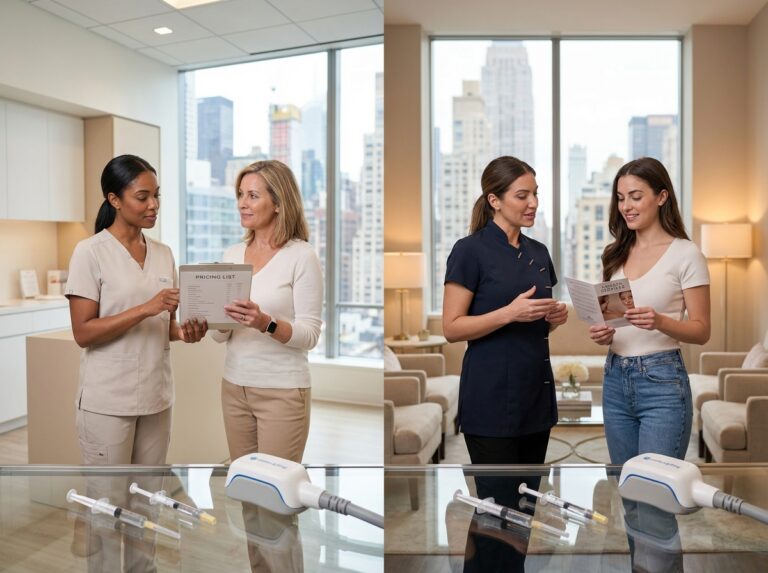
Shopping for non-surgical aesthetic treatments? This guide compares nurse injectors and dermatologists, typical U.S. prices for Botox, fillers and CoolSculpting, how clinics set fees, and practical steps to avoid overpaying. Read on to decide which provider and price make sense for the procedure, risks and your budget.
How clinics set prices for aesthetic treatments
Understanding the price tag on a syringe of filler or a laser session requires looking at the business ledger of the clinic. Patients often assume they pay strictly for the product and the time of the provider. The reality involves a complex web of fixed costs and strategic markups that determine the final bill.
The biggest factor driving price is not the Botox itself; it is the overhead required to keep the doors open. Rent in a prime metropolitan location consumes a massive portion of revenue. A clinic in a medical building in Manhattan or Beverly Hills pays exponentially more per square foot than a practice in a suburban strip mall. That rent cost gets divided and added to every single appointment slot.
Staffing costs vary wildly depending on the credentials of the person holding the needle. A board-certified dermatologist or plastic surgeon commands a high hourly rate due to their specialized training and insurance requirements. Malpractice insurance for a surgeon is significantly higher than for a registered nurse. When you choose a physician-run clinic, you cover that premium insurance and the doctor’s expertise. In contrast, many medspas operate under a “Medical Director” model. The clinic pays a physician a monthly fee to lend their license to the facility, while nurses or physician assistants perform the actual treatments. This lowers the payroll burden and allows the clinic to charge less while still maintaining a profit margin.
Equipment costs are another massive fixed expense. Devices for treatments like CoolSculpting or laser resurfacing are rarely bought outright; they are leased. On top of the lease, manufacturers charge a “consumable” fee. For every cycle of CoolSculpting or every pulse of certain lasers, the clinic pays the manufacturer a set fee. This creates a hard price floor. If a clinic pays $150 to the manufacturer every time they turn the machine on for a cycle, they cannot charge you $100 without losing money. This is why you rarely see legitimate discounts below a certain threshold for device-based treatments.
Business Models and Their Impact on Your Bill
The structure of the business dictates the pricing strategy. Franchise chains rely on volume. They negotiate bulk rates for neurotoxins and fillers directly from pharmaceutical companies like Allergan or Galderma. They can afford to sell Botox at a lower price per unit because they treat fifty patients a day. The goal is getting you in the door to sell memberships or packages.
Private physician practices operate on a different model. They see fewer patients but spend more time on assessment and anatomy. They rarely compete on price. Their value proposition is safety and artistic outcome. You pay a premium for the assurance that a doctor is handling complications if they arise.
Membership models have become standard in 2025. Clinics offer a monthly subscription fee that banks into a “wallet” for future treatments. This guarantees the clinic cash flow and usually unlocks a lower per-unit price for the patient. It creates loyalty and prevents patients from shopping around for the cheapest deal every three months.
Markup Strategies and Hidden Upsells
Clinics use specific strategies to make pricing look attractive while maximizing revenue. The most common is the “per unit” price for neurotoxins. A clinic might advertise $10 per unit to get you in the chair. Once you are there, they might recommend 60 units when you only budgeted for 30. This is a classic volume strategy.
Filler pricing is typically per syringe. The markup here is substantial. A syringe that costs the clinic $300 to $400 might be sold to the patient for $800 to $1,200. This margin covers the injector’s time, the room, the sterile supplies, and the profit. Some high-end clinics are moving toward “treatment area” pricing. Instead of charging for two syringes of cheek filler, they charge a flat fee of $2,500 for “Cheek Contouring.” This decouples the price from the commodity and places it on the result. It often results in a higher effective cost for the patient but guarantees a specific aesthetic outcome without haggling over half-syringes.
Low headline prices are often loss leaders. A clinic might offer a chemical peel at cost just to get a new patient into the database. During the consultation, the staff is trained to upsell skincare products or book a series of laser treatments where the real profit margins exist.
Regional Variations and Real-World Examples
Geography plays a massive role in pricing. The same syringe of Juvéderm Voluma does not cost the same to the patient in different zip codes. Competition drives this variance. In saturated markets like Los Angeles or Miami, you might find aggressive price wars among medspas. In smaller markets with only one or two high-end providers, prices remain high due to lack of competition.
Consider a standard treatment of 40 units of Botox and one syringe of lip filler. Here is how the pricing might look in late 2025:
| Provider Type | Location | Botox (40 units) | Lip Filler (1 syringe) | Total Cost |
|---|---|---|---|---|
| Medspa Chain | Midwest (e.g., Ohio) | $440 ($11/unit) | $650 | $1,090 |
| Nurse Injector (Private) | Major Metro (e.g., Dallas) | $560 ($14/unit) | $800 | $1,360 |
| Board-Certified Derm | Coastal Hub (e.g., NYC) | $1,000 ($25/unit) | $1,200+ | $2,200+ |
The price difference for the exact same product can exceed 100%. The premium in the third example pays for the doctor’s direct involvement and the prime real estate.
Transparency and Protecting Your Wallet
Negotiating medical aesthetics is not like buying a car. You generally cannot haggle the price per unit. You can ask about package incentives. Buying a package of three microneedling sessions upfront often reduces the single-session cost by 15% to 20%. Ask about manufacturer loyalty programs like Allē or Aspire. These points translate to real dollars off your treatment and the clinic should apply them for you.
Transparency is your right as a patient. Before a needle touches your face, ask to see the box. Verify it is a brand name product like Botox Cosmetic or Dysport, not a grey-market import. Ask exactly how many units or syringes are included in the quote. Clarify the policy on touch-ups. Some clinics offer a free touch-up for asymmetry within two weeks. Others charge full price for any additional units. Knowing these details prevents sticker shock at the checkout desk.
For a deeper look at specific costs for these treatments, Botox Pricing Guide 2025 offers a good baseline for what to expect in the current market.
Typical U.S. price ranges for Botox fillers CoolSculpting and other non surgical procedures
Knowing the baseline costs for aesthetic treatments in late 2025 helps you distinguish between a fair deal and a risky bargain. Prices have shifted upward over the last year due to inflation and rising supply costs. The numbers below reflect national averages for the United States. You will see higher figures in coastal hubs like New York or Los Angeles and lower figures in the Midwest or South.
Neuromodulators: Botox, Dysport, Xeomin, Daxxify
Most clinics price neuromodulators by the unit. Some practices charge by the area, but per-unit pricing offers more transparency regarding exactly how much product you receive. Botox pricing in 2025 generally falls between $12 and $25 per unit depending on the provider.
| Treatment Area | Typical Units Needed | Average Cost Range |
|---|---|---|
| Forehead Lines | 10 to 20 units | $150 to $400 |
| Glabella (11s between brows) | 20 to 30 units | $250 to $600 |
| Crow’s Feet (both eyes) | 20 to 24 units | $240 to $500 |
| Masseters (Jaw slimming) | 40 to 60 units | $500 to $1,200 |
Daxxify is a newer competitor that claims longer-lasting results. It often commands a premium of 30% to 50% over standard Botox or Dysport prices because patients require fewer visits per year.
Dermal Fillers: Hyaluronic Acid and Biostimulators
Fillers are priced per syringe. A standard syringe contains 1.0 ml of product. Some lip fillers come in 0.55 ml syringes, but the 1.0 ml size is the industry standard for most areas. Average filler cost in the U.S. sits around $750 to $900 per syringe for standard products, but specialized formulas cost more.
- Lips (Juvederm Ultra, Restylane Kysse): $700 to $950 per syringe. Most patients need only one syringe for a noticeable but natural result.
- Cheeks (Juvederm Voluma, Restylane Lyft): $850 to $1,200 per syringe. These are thicker gels meant for structural lift. A full cheek augmentation often requires two syringes.
- Tear Troughs (Under eyes): $800 to $1,100 per syringe. This area requires advanced skill and softer products like Restylane-L or Belotero.
- Jawline and Chin: $800 to $1,200 per syringe. Defining a jawline is volume-intensive and can require 2 to 4 syringes.
Biostimulators like Sculptra are priced per vial rather than per syringe. The 2025 average is $900 to $1,100 per vial. A typical rule of thumb is one vial per decade of life, meaning a 40-year-old might need four vials over several sessions.
Body Contouring and Fat Reduction
Non-surgical body treatments use different billing models. CoolSculpting Elite and similar cryolipolysis treatments charge per cycle. One cycle covers one specific spot where the applicator is placed. Treating a full abdomen usually requires four or more cycles.
| Procedure | Billing Unit | Typical Cost |
|---|---|---|
| CoolSculpting | Per Cycle (applicator placement) | $600 to $850 |
| CoolSculpting (Full Abdomen) | Total Treatment (4+ cycles) | $2,400 to $3,400 |
| Kybella (Double Chin) | Per Vial | $600 to $800 |
| Kybella (Full Treatment) | 2 to 4 sessions (multiple vials) | $1,200 to $3,000 |
Skin Resurfacing and Collagen Induction
Prices for skin treatments vary more than injectables because the technology ranges from simple mechanical devices to million-dollar laser platforms.
- Microneedling (SkinPen): $350 to $500 per session.
- Microneedling with PRP (Vampire Facial): $600 to $900 per session. The addition of Platelet-Rich Plasma increases the cost due to the blood draw and processing kit.
- Chemical Peels: $150 for light peels up to $400 for medical-grade medium-depth peels (VI Peel).
- Laser Resurfacing (Fraxel, Halo): $1,200 to $1,800 per session. These are aggressive treatments requiring physician oversight or advanced laser technicians.
Real-World Price Scenarios
To help you budget, here are three examples of what a total bill looks like in different practice settings for late 2025. These estimates assume a standard treatment of upper face Botox (50 units) and one syringe of lip filler.
Scenario 1: The Budget MedSpa
This provider is likely a newer nurse injector or a high-volume chain clinic. They might run monthly specials or membership deals.
- Botox (50 units at $11/unit): $550
- Lip Filler (1 syringe generic HA): $600
- Total: $1,150
Scenario 2: The Established Medical Practice
This is a mid-range option. The injector is an experienced Nurse Practitioner or Physician Assistant working under a reputable medical director.
- Botox (50 units at $15/unit): $750
- Lip Filler (1 syringe premium brand): $800
- Total: $1,550
Scenario 3: The Board-Certified Dermatologist
This is the premium tier. You pay for the doctor’s direct hand and extensive anatomical safety knowledge. Board-certified dermatologists typically charge the highest fees for injectables.
- Botox (50 units at $22/unit): $1,100
- Lip Filler (1 syringe premium brand): $1,000
- Total: $2,100
Factors That Drive the Price Up or Down
Several variables influence the final quote you receive during a consultation.
Provider Credentials
An injector with ten years of experience charges more than someone six months out of training. You are paying for their ability to handle complications and their artistic eye. A board-certified dermatologist or plastic surgeon has the highest hourly value, which reflects in their unit price.
Geography
Overhead costs in Manhattan or San Francisco force clinics to charge $18 to $25 per unit of Botox. A clinic in rural Ohio might stay profitable at $12 per unit.
Product Brand
Name-brand Botox (Allergan) and Juvederm often cost the clinic more to stock than competitors like Jeuveau or Versa. Clinics pass these supply costs to the patient.
Technique and Tools
Using a micro-cannula for filler reduces bruising and improves safety, but cannulas cost more than standard needles. Clinics that prioritize advanced safety equipment often have slightly higher fees.
Red Flags and Budgeting Advice
If a price looks too good to be true, it usually is. Be wary of Botox priced under $10 per unit in 2025. This can indicate over-diluted product (adding too much saline) or gray-market sourcing from unauthorized overseas vendors. Counterfeit devices and products are a real issue in the aesthetic market.
Avoid “Botox parties” in non-medical settings like hair salons or private homes. These environments lack the sterility and emergency equipment necessary if you have an allergic reaction or vascular event. Stick to licensed medical facilities.
When budgeting, remember that maintenance is not optional. Neuromodulators wear off in 3 to 4 months. Fillers last 9 to 18 months. A $500 Botox treatment is actually a $1,500 to $2,000 annual expense if you maintain the results year-round. Ask for a full annual treatment plan during your consult so you can budget for the total cost of ownership rather than just the initial visit.
Comparing qualifications safety and outcomes
The letters following a provider’s name dictate more than just the price per unit. They represent vastly different paths to holding that syringe. You need to understand these differences to decide where your money buys safety and where it just buys a brand name.
The Training Gap
Board-certified dermatologists and plastic surgeons spend a minimum of twelve years in training. This includes medical school and a residency focused specifically on anatomy, skin physiology, and surgical precision. Their deep understanding of facial vasculature comes from dissecting cadavers and performing surgery. They know exactly where the arteries run beneath the skin because they have seen them exposed.
Nurse injectors enter the field differently. Registered Nurses (RNs), Nurse Practitioners (NPs), and Physician Assistants (PAs) have solid medical foundations. However, their specific training in aesthetics often comes later. This usually happens through private certification courses, weekend workshops, or on-the-job mentorship. A certification course might last only a few days. It teaches the mechanics of injecting but cannot replicate years of surgical residency.
Scope of Practice and Supervision
State laws determine what a nurse can do without a doctor present. In many states, RNs must function under the supervision of a Medical Director. This doctor might be in the next room, or they might be miles away reviewing charts remotely.
You should always ask who the Medical Director is. In some “medspas,” the Medical Director is a retired physician from an unrelated field like radiology or gynecology who simply lends their license to the clinic for a fee. This is a red flag. You want a Medical Director who actually practices aesthetic medicine.
NPs and PAs generally have more autonomy. In some states, they can practice independently without direct supervision. They can prescribe medications and manage complications on their own.
Safety and Complication Management
The most critical difference between providers is not how well they inject. It is how they handle it when things go wrong.
Vascular occlusion happens when filler accidentally enters or compresses a blood vessel. This stops blood flow. If not treated immediately, it causes skin death (necrosis) or even blindness.
A board-certified specialist typically has a stocked emergency kit and the immediate authority to use it. They know the protocols to dissolve the filler and restore blood flow instantly. A nurse injector might need to call their supervising doctor for orders. That delay matters.
Board-certified plastic surgeons and dermatologists generally command higher fees because you are paying for this safety net. You are paying for their ability to recognize a crisis before it becomes a catastrophe.
When to Choose a Dermatologist or Surgeon
Certain areas of the face carry higher risks. The anatomy is unforgiving. You should prioritize a physician for these specific scenarios.
- Tear Troughs: The skin under the eye is thin. The blood vessels here connect directly to the ophthalmic artery. One mistake can affect vision.
- Liquid Rhinoplasty: The nose has a limited blood supply. It is the highest-risk area for vascular occlusion and blindness.
- Revision Work: If you have old filler that has migrated or formed nodules, you need a doctor to use ultrasound to map the old product and dissolve it safely.
- Deep Structural Work: Injections that mimic bone structure along the jawline or temples require placing product deep near major arteries.
When a Nurse Injector is Excellent Value
A highly experienced nurse injector can be a better choice than a general physician who rarely does aesthetics. Many nurses inject all day, every day. They develop an artistic eye and a gentle hand through sheer repetition.
You might find a nurse injector is the perfect fit for these treatments.
- Standard Neuromodulators: Botox or Dysport for the forehead, glabella, and crow’s feet are low-risk procedures in experienced hands.
- Lip Filler: This is a high-volume procedure for nurses. Many specialize specifically in lip augmentation and produce beautiful, subtle results.
- Cheek Volume: Standard mid-face volumizing is a core competency for aesthetic nurses.
Evaluating the Portfolio
Years in practice matter less than the number of procedures performed. A doctor who does one filler patient a week is less skilled than a nurse who does ten a day.
Ask to see a portfolio of healed results. Immediate after-photos show swelling. Healed photos taken two weeks later show the real skill. Look for consistency. If every pair of lips looks the same, that injector uses a “cookie-cutter” technique. You want an injector who adapts to individual anatomy.
Informed Consent and Protocols
Before any needle touches your face, the provider must discuss risks. If they say the procedure is “risk-free,” stand up and leave.
Ask specifically about their emergency protocol. Ask if they have hyaluronidase (the dissolving enzyme) on site. Ask if they have treated a vascular occlusion before. An honest provider will tell you that complications are rare but possible. They will explain exactly how they fix them.
Documentation is your safety line. The clinic must record the exact product used, the lot number, and the placement area. You need this information if you ever switch providers or have a reaction years later.
Choosing between a nurse and a doctor is a balance of risk, budget, and trust. You might see a dermatologist for your complex under-eye filler and see a talented nurse for your regular Botox maintenance. This hybrid approach often yields the best balance of safety and economy.
Practical steps to compare quotes and avoid overpaying
You have decided on the type of provider you want. Now the focus shifts to the financial side. Finding a fair price requires more than just scrolling through Instagram for the lowest number. It involves a systematic approach to ensure you pay for results, not just a brand name or a fancy waiting room. Here is a practical workflow to compare quotes and secure the best value without compromising your face.
Step 1: The Pre-Visit Vetting
Before you even pick up the phone, do your homework. A low price is irrelevant if the provider isn’t legitimate. You already know from the previous section how to distinguish between a nurse injector and a dermatologist regarding safety. Now, apply that to your pricing research.
Start by verifying the license. In 2025, most state medical boards have easy-to-use online search tools. Confirm the injector’s license is active and has no disciplinary actions. Once that baseline is set, look at reviews specifically mentioning billing. Search for keywords like “hidden fees,” “upsell,” or “honored quote.” If multiple patients complain about the final bill being higher than the estimate, take that as a warning.
Step 2: The Phone Screen
Clinics often try to be vague about pricing over the phone to get you in the door. Don’t settle for “it depends.” You need specific data points to make a valid comparison. When you call, ask these exact questions:
- Is pricing per unit or per area? This is critical for neurotoxins like Botox or Dysport. Per-area pricing often masks a lower dosage. Per-unit pricing is the only way to compare apples to apples.
- Which specific product brand will be used? There is a cost difference between premium brands and newer, cheaper competitors. Make sure a quote for “lip filler” specifies if it is Juvéderm, Restylane, or a budget alternative.
- Who is holding the syringe? Some clinics advertise a “doctor’s price” but schedule you with a nurse. Confirm exactly who performs the procedure.
- Are before-and-after photos available for this specific injector? Not the clinic’s stock photos, but work actually done by the person you are booking.
If the receptionist refuses to answer these basic questions or insists you must come in for a price, move on to the next clinic on your list.
Step 3: The In-Clinic Strategy
Once you are in the chair, the dynamic changes. You are now a patient, but you remain a customer. Insist on a consultation with the actual injector before any procedure begins. This is your time to align expectations with costs.
Request a written, itemized quote. This should list the exact number of units or syringes estimated for your goals. If you are getting CoolSculpting or laser treatments, ask for the total number of cycles or sessions required to see results. A single session price means nothing if you need four visits.
For injectables, safety and value overlap. If you have any doubts about the product, ask to see the packaging. In 2025, counterfeit products are a real market issue. Legitimate providers will happily show you the box, the lot number, and the expiration date. Filler Cost in 2025: Prices by State, Brand, and Treatment Area varies significantly, so verifying you are getting the authentic product you are paying for is a standard consumer right.
Ask about the “what if” scenarios. Does the price include a follow-up visit? If there is an asymmetry or a complication, is the correction covered, or will you be billed again? A slightly higher upfront cost that includes complication coverage is often better value than a bargain rate that leaves you paying full price for a fix.
Step 4: Evaluating Price vs. Outcome
Stop thinking about the price tag and start thinking about “cost per outcome.” A cheap injector might use 20 units of Botox where 40 are needed, resulting in movement returning in six weeks. You then have to pay for a whole new treatment sooner. That is not a deal.
Consider longevity. A board-certified dermatologist might charge $900 for a syringe of filler while a medspa charges $650. However, if the dermatologist uses a technique that places the product more effectively, lasting 18 months versus the medspa’s 9 months, the dermatologist is actually cheaper over time. Experienced hands often achieve better aesthetic results with less product because they know exactly where the place it for maximum lift.
Step 5: Identifying Behavioral Red Flags
Walk away if you encounter these warning signs during the pricing discussion:
- Refusal to itemize: If they give you a lump sum like “we’ll fix your face for $2,000” without breaking down units or syringes, they are hiding the math.
- High-pressure sales: Be wary of “today only” discounts that require you to sign immediately. Medical procedures should never be impulse buys.
- Bait and switch: You arrive for an advertised $10/unit special, but are told that price is only for a membership you have to buy, or for a different product than the one you wanted.
Step 6: Negotiation and Timing
You generally cannot haggle medical fees like a car purchase, but you can be smart about timing. Clinics often have manufacturer rebates (like Allé or Aspire rewards) that can save you $20 to $50 per visit. Sign up for these programs before you go.
Look for off-peak promotions. January and February are often slower months for aesthetics after the holiday rush. Clinics may offer legitimate specials to keep schedules full. Botox Pricing Guide 2025 trends show that seasonal demand heavily influences promotional offers.
Finally, get three quotes. Do not disclose the specific prices to the other clinics. Instead, use the knowledge to gauge the market rate. If a nurse injector quotes you $400 and a dermatologist quotes $1,200 for the exact same treatment plan, you have a decision to make based on your risk tolerance and budget. But if the dermatologist is $600 and the nurse is $550, the choice becomes much clearer.
Common patient questions answered
You have gathered your quotes and done the initial research. Now you likely have a list of specific worries keeping you from booking that appointment. Patients often have the same set of questions when deciding between a nurse injector and a board-certified dermatologist. Here are the honest answers regarding logistics and policies.
What does a consultation cost?
Dermatologists typically charge a consultation fee ranging from $150 to $300. This fee covers their medical expertise and time. They often apply this fee toward the treatment if you book same-day. Nurse injectors at med spas frequently offer complimentary consultations. This lowers the barrier to entry but can create pressure to buy immediately. Be aware that “free” often means the sales pitch will be more aggressive.
Do clinics guarantee touch-ups or refunds?
Medical aesthetics is not retail. You are paying for a service and a product that is consumed. Clinics almost never offer refunds if you are unhappy with the aesthetic result. If you need a touch-up because the Botox didn’t take fully or you want more volume, you usually pay for the additional units or syringes. Some clinics offer a “bank your Botox” membership where you get better rates on touch-ups, but free corrections are rare unless there was a clear error.
How many sessions will I need?
One appointment is rarely enough for a lifetime. Neurotoxins wear off in 3 to 4 months. You will need 3 to 4 visits a year to maintain a smooth forehead. Fillers last longer. You might need a top-up every 9 to 18 months depending on the product and your metabolism. Ask the provider for a realistic maintenance schedule so you can budget for the full year rather than just the first visit.
What do I do if I have a complication after hours?
This is the most important question to ask. You need to know who to call at 9 PM on a Friday. A reputable clinic provides an after-hours emergency line. If you experience severe pain, skin blanching (turning white), or vision changes, you cannot wait until Monday. If the clinic does not have an emergency line, you must go to the ER. Ensure the injector gives you their direct contact method for the first 48 hours post-treatment.
Final recommendations and how to decide
You have looked at the price charts and read the safety statistics. You understand the difference in training between a Registered Nurse and a Board-Certified Dermatologist. Now you are staring at two different price lists and trying to decide if saving $150 on a syringe is worth it. Making this choice comes down to risk management and the complexity of the procedure you want.
Weighing Price Against Safety and Experience
The sticker price is never the full story. When you see a low number, ask yourself what has been removed to get it there.
Experience costs money. A dermatologist charging $900 for a syringe of Voluma is charging for their fifteen years of medical school and residency. A nurse charging $650 is charging for their certification and practical hours. Both can yield good results, but the doctor charges for the depth of their medical liability and diagnostic capability.
Complication coverage is vital. Before you book, ask what happens if something goes wrong. If you have a delayed reaction on a Saturday night, does the nurse have a supervising physician on call? If you go to a dermatologist, you are already with the doctor. If you go to a med spa that operates without a clear medical director on site, your emergency plan is the ER. That ER visit will cost far more than the money you saved on the injection.
Product transparency matters. In 2025, the market is flooded with “gray market” products. These are genuine products imported illegally or counterfeits. Average filler cost in the U.S. is $750 per syringe, so be very suspicious of anyone offering prices significantly lower than the local average. A dermatologist is less likely to risk their medical license on unverified supply chains.
Your 5-Point Action Plan Before Booking
Do not book an appointment based on an Instagram ad alone. Follow this checklist to protect your health and your wallet.
- Research the specific provider, not just the clinic. A reputable clinic can still hire a rookie injector. Look for the specific name of the person holding the needle. Check their state license verification to ensure they are in good standing with no disciplinary actions.
- Get itemized quotes in writing. Verbal estimates change once you are in the chair. Ask for a breakdown that includes the cost of the product, the practitioner fee, and any facility fees. This prevents surprise charges at checkout.
- Check the portfolio for healed results. Freshly injected lips look plump but swollen. You need to see what their work looks like four weeks later. Look for photos that show the face at rest and in motion.
- Confirm the follow-up policy. Ask if a two-week follow-up appointment is included in the price. Good providers want to see you back to ensure symmetry and settle. If they charge extra just to check their own work, that is a red flag.
- Budget for contingencies. Never spend your last dollar on aesthetics. Keep a small buffer fund in case you need a touch-up or, in a worst-case scenario, need to pay to have the filler dissolved.
Final Recommendation
The smartest approach is to treat aesthetic procedures like any other contract work. You would not hire a contractor for your house without three bids. Do the same for your face.
Get a consultation with a nurse injector at a reputable med spa. Then get a consultation with a board-certified dermatologist. Compare the treatment plans. Often, the doctor might suggest a more conservative, holistic approach that uses less product, which might actually cost the same as a nurse who suggests multiple syringes.
Botox and fillers serve different purposes, and a higher-credentialed provider is often better at telling you “no” when a procedure will not give you the result you want. That honesty is worth paying for. Prioritize safety over small upfront savings. Your face is the one thing you wear every single day.
Sources
- Injectable Costs & Sculptra Pricing in 2025 – Spa Black — When weighing injectables cost against other cosmetic options, consider these comparisons: Injectables vs. Facelift: A facelift typically costs between $8,000-$ …
- How Much Do Injectable Fillers Cost in 2025? – Spa26 — Here's a comparison table that shows the average cost of injectable fillers by treatment area. … Board-certified dermatologists or plastic …
- Filler Cost in 2025: Prices by State, Brand, and Treatment Area — Average filler cost in the U.S. is $750 per syringe, with prices ranging $600–$1500 depending on treatment, location and filler brand.
- Restylane Kysse Price Per Syringe: 2025 Smart Guide – ProMD Health — A board-certified dermatologist or plastic surgeon typically charges between $700 and $900+ per syringe for Restylane Kysse. An experienced nurse injector …
- How much do Dermal Fillers Cost? – Suncoast Skin Solutions — The sticker price of dermal filler injectables differs according to the type of active ingredients within them. However, this injectable dermatology …
- Botox Pricing Guide 2025 | Understanding the Costs – Aesthetx — Discover the cost of Botox treatments in 2025. Explore factors influencing Botox pricing and learn how to choose a skilled provider for natural results.
- Botox vs. Dermal Fillers: Uses, Cost, Side Effects, and More – GoodRx — Botox is an injection used to paralyze targeted muscle groups to reduce wrinkles. Fillers are used to add volume under the skin.
- How Much Does 1ml of Lip Filler Cost? Your Ultimate Pricing Guide — Board-certified plastic surgeons and dermatologists generally command higher fees than nurse injectors at med spas, primarily because of their specialized …
Legal Disclaimers & Brand Notices
The content provided in this article is for informational and educational purposes only and does not constitute medical advice, diagnosis, or treatment. Always seek the advice of a qualified board-certified dermatologist, plastic surgeon, or other licensed healthcare provider with any questions you may have regarding a medical condition or specific aesthetic procedure. Never disregard professional medical advice or delay in seeking it because of something you have read in this article.
Vampire Facial® and Vampire Facelift® are registered trademarks of Charles Runels, MD. The specific procedures described in this article are generic representations of platelet-rich plasma (PRP) treatments and are not affiliated with, endorsed by, or certified by the trademark owner.
All product names, logos, and brands mentioned in this text—including but not limited to Botox, Dysport, Juvéderm, Restylane, Sculptra, Radiesse, SkinPen, HydraFacial, CoolSculpting, and PicoSure—are the property of their respective owners. All company, product, and service names used in this article are for identification purposes only. Use of these names, trademarks, and brands does not imply endorsement.